Our Madagascar cycling holidays
Our Madagascar cycling holidays let you leave the four-wheel drive behind and pedal you off on adventures in remote areas. You’ll work your way through village-dotted highlands, rice paddies, seaside towns, wide savannah and the famous Avenue of the Baobabs. Rest days out of the saddle are for relaxation – or you could opt to visit a lemur sanctuary, go canoeing from your riverside camp, or take a stroll around the city of Andsirabe. Group tour sizes are kept small – all the better for chatting to your new companions and passersby en route. Our Madagascar cycling holidays support local people and businesses – for instance, paying for seedlings for reforestation projects, helping to preserve the island's forests for the people and wildlife that rely on them.
Our top trip
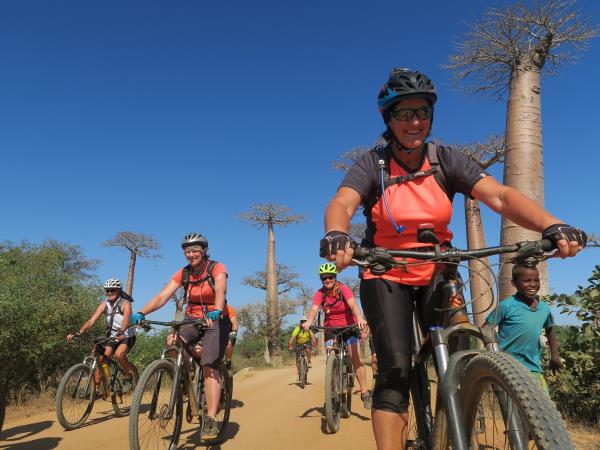
Madagascar cycling tour
Extraordinary Madagascar by bicycle
From
NZ $6650
16 days
ex flights
Small group travel:
2026: 6 May
2026: 6 May

Contact Us
Call us for a chat about our holidays. We are happy to discuss your holiday and help in any way we can. No bots, queues or awful hold music.

01273 823 700
Call us until 6pm
Calling from outside the UK

What do cycling holidays in Madagascar involve?
Who will I travel with on a Madagascar cycling holiday?
Our Madagascar cycling holidays are mostly small group holidays, with a maximum of 12 riders per group. “The kind of people who come on our trips are people who want a real adventure and not some glossed over experience,” says Mandy Richards from our cycling holiday partners Escape Adventures. “We try to keep it as open as possible because we love having a mixture of nationalities and a mixture of ages on our trips. The more diverse the group the more fun it is. But a lot of our bikers are in the age group where their kids have just left home, so people in their fifties and sixties.”
You’ll also be accompanied by an experienced tour leader, who will either be Madagascan or will have plenty of in-country experience, both of travelling in Madagascar and of remote cycling and trekking. There’ll also be a Malagasy mechanic, driver and perhaps an additional guide, who’ll be able to give you the inside info on Madagascar's culture.
How fit do I need to be for a Madagascar cycling holiday?
Cycling holidays in Madagascar aren't for the inexperienced rider, and you'll need to reasonably fit and used to cycling at home – either that or put in some serious prep before you leave. Depending on the tour you choose, you’ll cycle anything between 15km and 100km a day, on a mixture of dirt and tarmac roads and with some hilly climbs, especially if cycling through the highlands.“There’s definitely some challenging terrain here,” says John Etherington, the founder of Escape Adventures. “There’s hills and there’s sand and we go to areas that are very isolated. But we have a support vehicle as well, so it’s challenging at times, but you’re not trying to pump out the kilometres.” Open minds are as essential as good gear. The weather and terrain are changeable, so no matter how well-planned your trip may be, flexibility has to be built in. These are remote landscapes, and the privilege of exploring them will always come with a certain level of unpredictability.
Tours will also avoid the main roads as much as possible. “They’re quite narrow and they’re quite busy with trucks, so avoiding those is better for enjoying your cycling. You need to get off them and head out,” says Mandy . “There are a lot of tarmac or paved roads that are quiet. Most people once you get out of the cities don’t own a car. So, in the more rural areas you’ll just see a few buses and vans and the occasional truck but not lots of traffic. And then you have the dirt roads, which can be pretty rough.”
One thing a Madagascar cycling holiday is not is a race, and you’ll always have time to stop off, to go on walks, explore national parks, or to canoe or boat down little-explored river systems. “Our tours are not for people who want to do huge distances or get somewhere as fast as possible,” says Mandy. “They’re designed for people who want to be active while also experiencing the country as it really is. If you see a bullock cart coming along the road or someone heading into the fields, there’s always time to stop and have a chat.”
Sleeping & eating on a Madagascar cycling holiday
Our Madagascar cycle holidays typically stay in simple, local-style hotels and guest houses, which are low on polish but high on local character and charm. More high-end accommodation with plush rooms and managed beachfront tranquillity may offer luxury and more comfort, but this type of place isn't the best option for getting a taste of daily life in Madagascar. “We believe that people will have a more authentic and more genuine experience if they stay in small, locally owned properties,” says Mandy. “A lot of them don’t usually host overseas tourists, they’re more likely to host local travellers. It’s really special because they value our visits so much, so we get to interact with them and we get home-cooked meals sometimes, which our riders love.”“The food is amazing,” she adds, “in Madagascar they have a real food culture, with a strong Indian and French influence. They’ll just cook up what they've got and it’ll be amazing… They’ll do rice and they’ll give you a choice of chicken, fish or beef, and it’ll be with a nice delicate sauce.” It’s not just in the city that you get great food, but in remote rural areas too, she says. ”You’ll find amazing restaurants in tiny towns in the middle of nowhere, and you’ll wonder, ‘What’s this doing here?’”
Wildlife watching
“In the areas we go to you don’t see much wildlife when you’re cycling around,” says John Etherington. “We do go and visit wildlife reserves as we go along, where the lemurs are, for example, so we build that in. Madagascar has had a lot of deforestation and the downside of that is that the wildlife tends to be in the parks, though if you know where to look you can see things like chameleons on the road.”
With 80 percent of its species found nowhere else on earth – including birds, more than half the world’s chameleons, several different species of lemur and the Malagasy giant rat, which can jump three feet into the air – it’s Madagascar’s wildlife that draws many tourists here, but don’t expect to see it everywhere you go. As John says, while you may be lucky enough to encounter wildlife along remote riverbanks or in the forests, it’s in the more popular national parks, included in all our cycling itineraries, where you are most likely to encounter Madagascar’s charismatic creatures.
With 80 percent of its species found nowhere else on earth – including birds, more than half the world’s chameleons, several different species of lemur and the Malagasy giant rat, which can jump three feet into the air – it’s Madagascar’s wildlife that draws many tourists here, but don’t expect to see it everywhere you go. As John says, while you may be lucky enough to encounter wildlife along remote riverbanks or in the forests, it’s in the more popular national parks, included in all our cycling itineraries, where you are most likely to encounter Madagascar’s charismatic creatures.