Trekking in the Karakoram Mountains

High altitude hijinks in a land of giants![]()

“Karakoram is like a time machine. When I go there it reminds me of how my father and grandfather used to live, what a simple life looks like.” Umer Latif is the co-founder of our Pakistan trekking partner Beyond the Valley. On a holiday in the Karakoram Mountains and wanting to trek, he and his wife, Hina, struggled to find a suitable tour operator. So, being entrepreneurial types, they resolved to create their own and in doing so make one of the world’s great adventure travel destinations accessible to more people.
And what a place it is. Pakistan’s Karakoram Mountains boast 18 peaks over 7,500m, and four over 8,000m, including K2 which is second in height only to Mount Everest, as well as vast glaciers up to 76km long. The cirque of Concordia, where the Baltoro and Godwin-Austen glaciers converge, is known as ‘the throne room of the mountain gods’. Pop open your tent flaps on a Concordia trekking holiday, and if it’s a clear morning you’ll be taking in some of the most awe-inspiring scenery on Earth. Scenery, by the way, that not many other international tourists have seen.
“Before the 1970s and the Karakoram Highway these mountains were almost cut off from the rest of the country,” says Umer, whose enthusiasm for the region is profound. “The only way to access them was by flying. The valleys still have an agricultural economy and most income comes from bartering, trading. When I visit places like Zermatt or Chamonix, I love how they are so accessible to people, but you go to 3,000m and there’s a pub waiting for you. In the Karakoram valleys you’ll be walking in villages where the children will be going to school and the women will be working in the fields and they’re not expecting to encounter tourists, so you come back with some real stories to tell. It will change, of course, sooner or later. That’s why we want to lead by example on responsible principles.”
What does ‘responsible principles’ mean in practice when trekking in Pakistan? Respect for the landscapes, certainly, by ensuring that no waste is left behind, and that rivers and streams aren’t polluted. Seeking out locally run accommodation that uses water carefully in an area where glacier retreat is a real and present threat. But most of all, cultural immersion. The inhospitability of these jagged peaks is in direct contrast to the warmth of the reception you’ll get as you pass through remote Karakoram communities, travelling with a local guide, with friendly greetings at all times, and even the occasional invitation for tea.
And what a place it is. Pakistan’s Karakoram Mountains boast 18 peaks over 7,500m, and four over 8,000m, including K2 which is second in height only to Mount Everest, as well as vast glaciers up to 76km long. The cirque of Concordia, where the Baltoro and Godwin-Austen glaciers converge, is known as ‘the throne room of the mountain gods’. Pop open your tent flaps on a Concordia trekking holiday, and if it’s a clear morning you’ll be taking in some of the most awe-inspiring scenery on Earth. Scenery, by the way, that not many other international tourists have seen.
“Before the 1970s and the Karakoram Highway these mountains were almost cut off from the rest of the country,” says Umer, whose enthusiasm for the region is profound. “The only way to access them was by flying. The valleys still have an agricultural economy and most income comes from bartering, trading. When I visit places like Zermatt or Chamonix, I love how they are so accessible to people, but you go to 3,000m and there’s a pub waiting for you. In the Karakoram valleys you’ll be walking in villages where the children will be going to school and the women will be working in the fields and they’re not expecting to encounter tourists, so you come back with some real stories to tell. It will change, of course, sooner or later. That’s why we want to lead by example on responsible principles.”
What does ‘responsible principles’ mean in practice when trekking in Pakistan? Respect for the landscapes, certainly, by ensuring that no waste is left behind, and that rivers and streams aren’t polluted. Seeking out locally run accommodation that uses water carefully in an area where glacier retreat is a real and present threat. But most of all, cultural immersion. The inhospitability of these jagged peaks is in direct contrast to the warmth of the reception you’ll get as you pass through remote Karakoram communities, travelling with a local guide, with friendly greetings at all times, and even the occasional invitation for tea.
Real cultural exchange requires time, and trekking is the natural way for that to happen.![]()
“Cultural exchange is integral to adventure tourism, but I feel that a lot of the time it’s a curated experience,” says Umer. “For example, if you go to a homestay in a village the host family may cook for you, but they will likely have been told in advance what to prepare, and you have limited interaction time with your hosts. In my view real cultural exchange requires time, and trekking is the natural way for that to happen.”
People here speak very good English, and most guides even speak the basics of other languages because international climbers have been coming here for decades. As you walk your guides and porters will share their lives with you, and their knowledge about the mountains’ history, wildlife and botany. They’ll also ask about you and your life back home as well, with genuine enthusiasm. That’s because there is no ‘tourism fatigue’ in the Karakoram Mountains yet, says Umer – what we here at Responsible Travel would call overtourism. “Too many tourists make tourism feel like just another job. People coming to Pakistan now are seeing it before this fatigue sinks in.”
People here speak very good English, and most guides even speak the basics of other languages because international climbers have been coming here for decades. As you walk your guides and porters will share their lives with you, and their knowledge about the mountains’ history, wildlife and botany. They’ll also ask about you and your life back home as well, with genuine enthusiasm. That’s because there is no ‘tourism fatigue’ in the Karakoram Mountains yet, says Umer – what we here at Responsible Travel would call overtourism. “Too many tourists make tourism feel like just another job. People coming to Pakistan now are seeing it before this fatigue sinks in.”

Karakoram Mountains Map
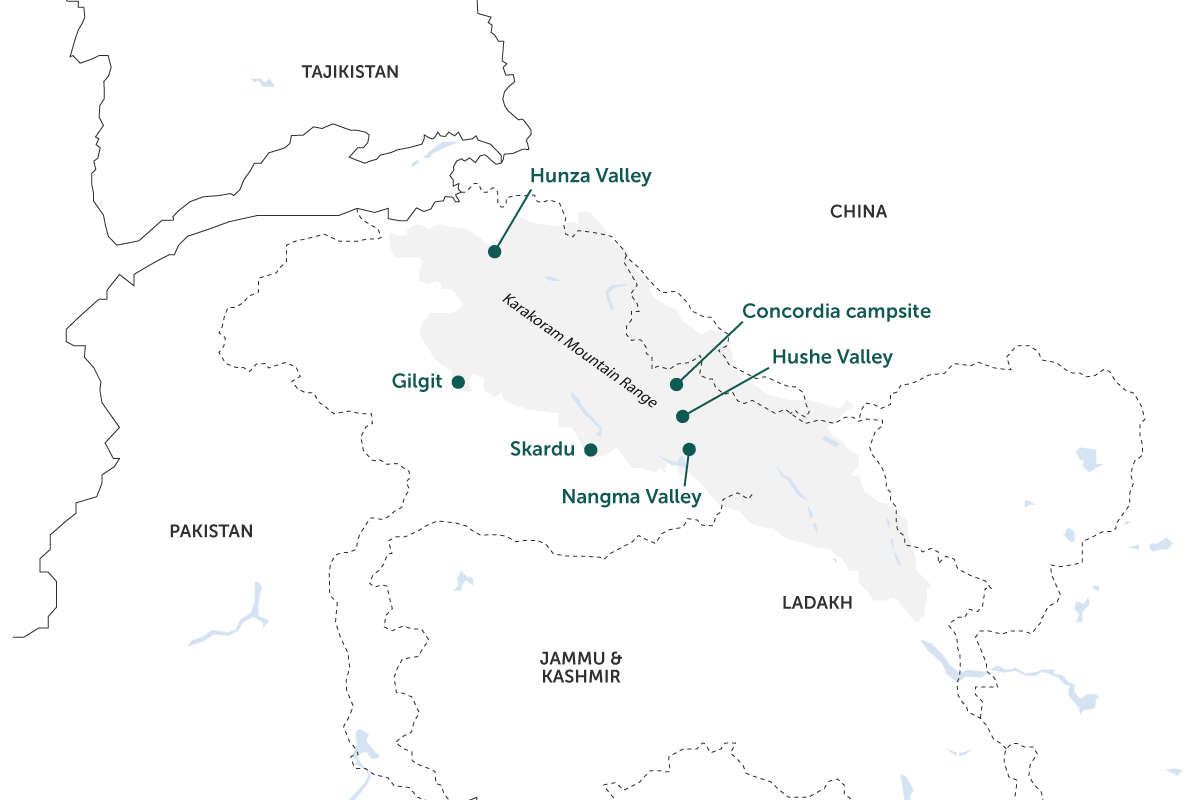
Where can Karakoram Mountains treks take you?
Herds of goats tinkle melodically past as they flow around you on paths by glacial streams, while at higher elevations ibex and markhor keep a warier distance. Flowery pastures are dotted with shepherd huts, and in the shadows of the mountains people work their fields, or tend their livestock. “Every valley offers different landscapes, different culture, different food,” says Umer. “For example, fields that are irrigated by lots of glacier water might be abundant in apricots, or depending on the height you might get an excellent potato crop.”In Pakistan trekking circles the Nangma Valley is known as the Karakorams’ Yosemite for its steep rock walls and towers. Treks in the Nangma Valley can finish with the Thalay La pass, offering spectacular valley panoramas as well as views of the Masherbrum range. You can trek to the Masherbrum base camp at 4,200m through the Hushe Valley on a relatively easy route involving five days of walking there and back. Trekking to the K7 basecamp through the Charakusa Valley is more challenging, with spells on the glacier, occasionally on snow and ice.
And if you want to take a more relaxed approach, you can fly into Gilgit rather than Skardu and spend two weeks exploring the Hunza, Chitral, Kalash and Swat valleys, with a stirring mountainous backdrop. The villages among these valleys are some of the oldest communities on the Silk Road. Trekking in Pakistan’s villages you might catch a game of polo, stay in a campsite surrounded by the white flowers of wild onions, browse the stalls at Chitral’s old bazaar, or admire the region’s brightly decorated trucks, originally personalised by long-distance drivers, but now a form of folk art.

Nangma and Thallay La trek in Pakistan
Off the beaten track to Nangma and Thallay La
From
£2100
15 days
ex flights

K7 base camp trek in Pakistan
A beautiful & challenging trek to Charakusa valley Karakoram
From
£1950
12 days
ex flights

Masherbrum basecamp trek, Pakistan
Easy trek straight to the foot of mighty Masherbrum (7821m)
From
£1680
11 days
ex flights


Nangma Valley trekking holiday in Pakistan
A stunning trek known as 'The Yosemite of Pakistan'.
From
£1700
10 days
ex flights

Thallay La trekking holiday in Pakistan
Trekking from Khaplu to Shigar via the stunning Thallay La!
From
£1700
11 days
ex flights


Contact Us
Call us for a chat about our holidays. We are happy to discuss your holiday and help in any way we can. No bots, queues or awful hold music.

01273 823 700
Call us until 6pm
Calling from outside the UK

What does trekking in the Karakoram Mountains involve?
Our Karakoram Mountains holidays are typically small group tours. They are led by expert local mountain guides who will take care of everything for you in terms of meals and setting up camp, leaving you free to enjoy the scenery.
Where are the Karakoram Mountains?
This vast mountain system, less inhabited than the neighbouring Himalayas, runs for around 500km in the disputed region of Kashmir, and most of the peaks lie in the Gilgit-Baltistan territory that is administered by Pakistan. Much of the area is glaciated, but these glaciers are often covered in rubble, so they are not shrinking at as fast a rate as elsewhere. They are not immune to the climate crisis, though, and the future will likely hold both flooding and water scarcity. K2, the second-highest mountain in the world, is in the northwest of the range, west of the Khunjerab Pass, which is the highest point on the Karakoram Highway.
Getting in & getting around
There are two principal gateways to the Karakoram Mountains: the city of Gilgit, for the wider Gilgit region, is a 40-minute flight from Islamabad, and Skardu, for the Baltistan region, is an hour’s flight. Skardu’s colourful bazaar is a very exciting place to spend a day or so before you set off in 4WDs to begin your trekking. If bad weather prevents flying you may also drive in via the 1,300km-long Karakoram Highway, which traces one of the ancient Silk Road routes, and is one of the highest paved roads in the world.
When to go
Most of our mountain trekking holidays depart in August though some go as early as June. Lower down in the valleys you can walk from May to October. “I think the best time is autumn,” says Umer. “I love the spring blossoms, too, but for me it’s October, going around in the valleys and villages, all the poplar trees are golden, the nights are cooler, and there are fewer people around.”
In summer the weather is generally warm and sunny, though even in August at higher elevations you’ll still need a fleece for nighttime. But mountain weather can turn quickly so itineraries will typically factor in an extra day or two to account for any bad weather that impedes progress.
In summer the weather is generally warm and sunny, though even in August at higher elevations you’ll still need a fleece for nighttime. But mountain weather can turn quickly so itineraries will typically factor in an extra day or two to account for any bad weather that impedes progress.
The beauty of the Karakoram Mountains is that they can provide for the beginner trekker looking for a few hours a day at a gentle gradient, and tougher treks with steeper ascents and higher elevations for those wanting more challenge.![]()
How fit do I need to be?
For our more challenging treks you can expect daily distances up to around 17km, with elevation gains up to 450m – the trek to K2 basecamp and Concordia, however, is extremely demanding and should only be undertaken by experienced trekkers prepared for the isolation and altitude involved.
On easier routes, such as our trek to Masherbrum basecamp, the daily distances can be as low as 10km. Although the pace stays relaxed throughout, you will still want to be an experienced and fit walker, and a few long-distance walks before your holiday will be useful practise.
On easier routes, such as our trek to Masherbrum basecamp, the daily distances can be as low as 10km. Although the pace stays relaxed throughout, you will still want to be an experienced and fit walker, and a few long-distance walks before your holiday will be useful practise.
Where do we stay?
This region does not have tea house culture like Nepal; you are not walking hut to hut. Irrespective of the trek you choose, you’ll be camping expedition-style, so you’ll have local porters, guides, and a cook, all from the valleys you’re walking in. Porters carry everything in that you’ll need, and carry it out again afterwards – our holidays leave no waste whatsoever, to help keep these magnificent landscapes pristine. “The porters are superhumans,” says Umer, “going ahead and setting up the sleeping tents, the toilet tents, the kitchen tent, the mess tent, even the shower tent.”
And if you’re picturing tins of beans cooked over a tiny stove, you couldn’t be more wrong. Groups have their own expedition camps with them, and even at 5,000m they can whip up an excellent biryani as well as pizzas and pasta. You get a proper, freshly cooked meal every day – sometimes groups will carry their own chickens with them. “Even in lower parts of Pakistan such as Lahore, when you eat a very good meal the chef will often be Balti; that’s how good they are,” says Umer. “Back in the day the ‘hard’ adventurers, the Italians, the British, came here to climb huge peaks, and that requires lots of calories. You can’t do it on sandwiches.”
And if you’re picturing tins of beans cooked over a tiny stove, you couldn’t be more wrong. Groups have their own expedition camps with them, and even at 5,000m they can whip up an excellent biryani as well as pizzas and pasta. You get a proper, freshly cooked meal every day – sometimes groups will carry their own chickens with them. “Even in lower parts of Pakistan such as Lahore, when you eat a very good meal the chef will often be Balti; that’s how good they are,” says Umer. “Back in the day the ‘hard’ adventurers, the Italians, the British, came here to climb huge peaks, and that requires lots of calories. You can’t do it on sandwiches.”
More Pakistan articles

Travelling in winter is generally a no-no as much of the landscape is covered in snow.

Pakistan is profound. Overcome media and myths to go and explore this extraordinary country...

Look beyond the headlines and you’ll find a fascinating and welcoming country.


