Taking the Sky Train to Tibet
With the Trans-Siberian and Trans-Mongolian lines off limits to most travellers due to the Russia-Ukraine war, consider this record-breaking long distance rail journey into Tibet instead.
The high-altitude Qinghai–Tibet railway, also known as the Sky Train, runs from the city of Xining in Qinghai Province to Lhasa, Tibet, and takes around 20 hours. The fact that this route exists – and that you can travel it – is remarkable.
For £40 you can get on a train in Beijing, ride it for 40 hours, and reach Lhasa, Tibet at the other end. In doing so you’ll have travelled over 2,500 uninterrupted kilometres west, including the famous Sky Train route.
There are a number of reasons why you wouldn’t do this – the first is that you’ll be on a ‘hard seat’ – a standard train seat, with nowhere to sleep. The second is that there are just seven stops on the way, and no time to go off and sightsee. Rather than making a beeline from Beijing, try our more leisurely Sky Train to Tibet holiday.
The high-altitude Qinghai–Tibet railway, also known as the Sky Train, runs from the city of Xining in Qinghai Province to Lhasa, Tibet, and takes around 20 hours. The fact that this route exists – and that you can travel it – is remarkable.
For £40 you can get on a train in Beijing, ride it for 40 hours, and reach Lhasa, Tibet at the other end. In doing so you’ll have travelled over 2,500 uninterrupted kilometres west, including the famous Sky Train route.
There are a number of reasons why you wouldn’t do this – the first is that you’ll be on a ‘hard seat’ – a standard train seat, with nowhere to sleep. The second is that there are just seven stops on the way, and no time to go off and sightsee. Rather than making a beeline from Beijing, try our more leisurely Sky Train to Tibet holiday.

It’s so high that a nearby town’s name is Tibetan for ‘town that eagles cannot pass over’![]()

The train line west from Xining used to end at the city of Golmud. Reaching Lhasa, Tibet meant a bumpy 30+ hour bus ride over the Kunlun Mountains. The stretch of line from Golmud to Lhasa opened in 2006, after half a century of construction – during which everyone from Paul Theroux (author of Riding the Iron Rooster) to governments – said that the project was too much of a technical challenge to complete.
Despite the unstable permafrost and a hostile climate, this 1,956km-long line spends 960km running at 4,000m above sea level through the Tibetan Plateau. It reaches an altitude of 5,702m to get over the Tangula Pass. That’s higher than Everest Base Camp, so high that there’s emergency oxygen on board the train, and so high that a nearby town’s name is Tibetan for ‘town that eagles cannot pass over’.
Much of the land the train crosses is unstable due to melting permafrost, meaning that large sections of the line must run on bridges. The bridges elevate the tracks and stop them sinking into the ground, and there are tunnels under the embankments to allow yaks and their herders to roam free. In other places, the tracks are cooled so that they don’t melt the frozen ground below.
There are plans to expand this formidable rail network to Kathmandu, Nepal, as well, and it already extends into Nyingchi, Tibet and Shigatse, Tibet.
The Sky Train is not without its critics. It is, after all, representative of China’s predatory inroads into the Tibet Autonomous Region. The country is investing in water projects in Tibet, and moving Han Chinese people into the region – there are now more Han Chinese people in Tibet than native Tibetans and the Sky Train is emblematic of this ease of movement, and brings further large-scale tourism into Tibet from the east.
Despite the unstable permafrost and a hostile climate, this 1,956km-long line spends 960km running at 4,000m above sea level through the Tibetan Plateau. It reaches an altitude of 5,702m to get over the Tangula Pass. That’s higher than Everest Base Camp, so high that there’s emergency oxygen on board the train, and so high that a nearby town’s name is Tibetan for ‘town that eagles cannot pass over’.
Much of the land the train crosses is unstable due to melting permafrost, meaning that large sections of the line must run on bridges. The bridges elevate the tracks and stop them sinking into the ground, and there are tunnels under the embankments to allow yaks and their herders to roam free. In other places, the tracks are cooled so that they don’t melt the frozen ground below.
There are plans to expand this formidable rail network to Kathmandu, Nepal, as well, and it already extends into Nyingchi, Tibet and Shigatse, Tibet.
The Sky Train is not without its critics. It is, after all, representative of China’s predatory inroads into the Tibet Autonomous Region. The country is investing in water projects in Tibet, and moving Han Chinese people into the region – there are now more Han Chinese people in Tibet than native Tibetans and the Sky Train is emblematic of this ease of movement, and brings further large-scale tourism into Tibet from the east.

Life on board the Sky Train
If you’re heading into Tibet, the scenery on the rest of your holiday will be more spectacular than what you see on the train. But the train view gives you something very impressive in scale.
Before you board, join the other passengers cleaning their windows to get the best view.![]()
The Tibetan plateau is made for traversal and it’s by train that you can see its true scope. This high, dry place is a frozen desert lying in the rain shadow of the Himalayas. The whole plateau is 4,000m above sea level, surrounded by the world’s highest mountains, and containing the largest area of permafrost on the planet. Winds sweep across it uninterrupted by trees. Occasionally, you’ll see the flash of grazing antelope, hard to pick out against the yellow plain.
At Xining and other major departure stations you might find people on the platform cleaning their windows for the journey ahead using a pack of disposable tissues. And there are tables and chairs set up at the windows so people can sit enjoying the view. There are also rest stops where you can alight and go to viewing platforms, taking in the scenery without a tissue-wiped window in the way.
These trains have three types of ticket: space in soft sleepers with four bunks, space in hard sleepers with six bunks stacked three high, and tickets for the hard seats. There are squat toilets and sitting toilets, and a buffet car which some travellers avoid by making judicious use of instant noodles.
At these heights, altitude sickness is a risk, especially for international travellers who have not experienced it before and who may react badly. Going by train allows you to acclimatise slowly to increasing the altitude, and most people usually feel better after a couple of days. There are two oxygen systems on board, including emergency oxygen delivered by mask, for direct use by passengers. Travellers must fill in health forms before they board.
At Xining and other major departure stations you might find people on the platform cleaning their windows for the journey ahead using a pack of disposable tissues. And there are tables and chairs set up at the windows so people can sit enjoying the view. There are also rest stops where you can alight and go to viewing platforms, taking in the scenery without a tissue-wiped window in the way.
These trains have three types of ticket: space in soft sleepers with four bunks, space in hard sleepers with six bunks stacked three high, and tickets for the hard seats. There are squat toilets and sitting toilets, and a buffet car which some travellers avoid by making judicious use of instant noodles.
At these heights, altitude sickness is a risk, especially for international travellers who have not experienced it before and who may react badly. Going by train allows you to acclimatise slowly to increasing the altitude, and most people usually feel better after a couple of days. There are two oxygen systems on board, including emergency oxygen delivered by mask, for direct use by passengers. Travellers must fill in health forms before they board.
The Sky Train route
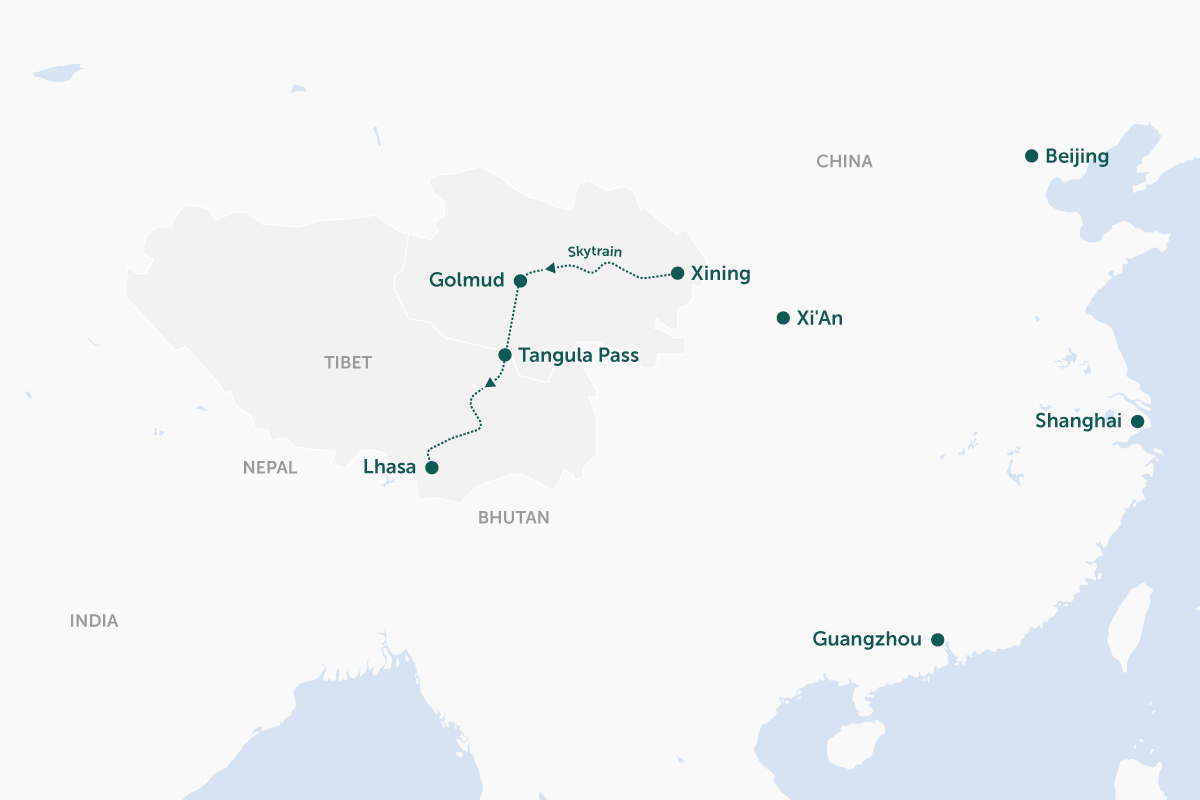
Beijing is the starting point of many rail adventures into Tibet and there are daily trains from Beijing to Lhasa. Before you hop on board, most of our holidays will give you time to explore the city, both forbidden and unforbidden. You can also travel to Lhasa from cities like Shanghai and Guangzhou. You might also join at Xian, where you can go and see the city’s amazing, famous Terracotta Army before heading west.
A few hundred kilometres later you’ll enter China’s largest province, Qinghai, and its capital, Xining, where the Qinghai-Tibet Railway officially starts, beginning by wrapping around the border of Qinghai Lake, the second largest saltwater lake in the world. Most of the province is on the Tibetan Plateau. Kilometres of dry expanse follow; former Silk Road routes are now peppered with construction projects and heavy industry. It’s after the city of Golmud that the scenery gets really interesting, especially once the Kunlun Mountains hove into view.
There are a handful of train stations with viewing platforms after Golmud, including one just a kilometre before the high-altitude Tangula Pass. Alight at Tangula Railway Station, the highest in the world, and you’ll find the air is half as oxygen-rich as it is at sea level.
Once you reach Lhasa, none of the city’s rapid modernisation can dim the massive majesty of the famous Potala Palace, its thousand rooms and thirteen storeys rising high above the city. Lhasa is a springboard from which you can launch off into exploring the rest of Tibet.
A few hundred kilometres later you’ll enter China’s largest province, Qinghai, and its capital, Xining, where the Qinghai-Tibet Railway officially starts, beginning by wrapping around the border of Qinghai Lake, the second largest saltwater lake in the world. Most of the province is on the Tibetan Plateau. Kilometres of dry expanse follow; former Silk Road routes are now peppered with construction projects and heavy industry. It’s after the city of Golmud that the scenery gets really interesting, especially once the Kunlun Mountains hove into view.
There are a handful of train stations with viewing platforms after Golmud, including one just a kilometre before the high-altitude Tangula Pass. Alight at Tangula Railway Station, the highest in the world, and you’ll find the air is half as oxygen-rich as it is at sea level.
Once you reach Lhasa, none of the city’s rapid modernisation can dim the massive majesty of the famous Potala Palace, its thousand rooms and thirteen storeys rising high above the city. Lhasa is a springboard from which you can launch off into exploring the rest of Tibet.

Bejing to Lhasa tour, by train
Beijing to Lhasa and Kathmandu on the famous sky train
From
£1600 to £2300
13 days
ex flights


Contact Us

Call us for a chat about our holidays. We are happy to discuss your holiday and help in any way we can. No bots, queues or awful hold music.

01273 823 700
Call us until 6pm
Calling from outside the UK

The benefits of an organised tour
Since independent travel isn’t permitted in Tibet, booking one of our holidays on the Sky Train could be your best way into the country. As the line grows more popular, booking a ticket independently is getting harder – even months in advance, and especially in July and August, which are peak travel months. Booking with an organised tour is the best way to secure your ticket.
We can also help with your Tibet travel permit application; you can be asked to leave the train if you do not have it. Going with a local guide can help you communicate with the train guards, and with other passengers; English is not widely spoken. Additionally, if you go on a small group tour you’ll be sharing the sleeper cabins with members of your group, which can be more appealing than travelling solo and sharing with strangers. Especially if you’ve chosen to do all 40 hours, non-stop, from Beijing.
We can also help with your Tibet travel permit application; you can be asked to leave the train if you do not have it. Going with a local guide can help you communicate with the train guards, and with other passengers; English is not widely spoken. Additionally, if you go on a small group tour you’ll be sharing the sleeper cabins with members of your group, which can be more appealing than travelling solo and sharing with strangers. Especially if you’ve chosen to do all 40 hours, non-stop, from Beijing.
More Tibet articles

See the world from a higher perspective in Tibet, exploring from Lhasa to the edge of Everest National Park.

Head to Tibet from May to October to enjoy the sunshine at altitude, but don’t discount winter in Lhasa.


There's much more to Lhasa than simply somewhere to acclimatise before moving on.

You won't find the Dalai Lama in Tibet, not in person, nor in photos, books or teachings.

Up there at the roof of the world, Tibet is one of the great destinations for a trekking holiday.

Learn about the different ways of getting to Base Camp North and Rongbuk Monastery - you can even drive.

You only have to acclimatise once by visiting Tibet, Nepal and Bhutan together.

Our Asia experts and partners based in the country offer up their top Tibet travel advice, plus tips from our reviews.

Responsible tourism in Tibet is a tricky issue – starting with “should I even go?” .


