Philippines travel guide
The vast Philippines archipelago acts as gatekeeper between the Pacific and the South China Sea, sitting squarely on trading routes used by Chinese, Indians, Malaysians, Arabs, Austronesians and more, many of whom settled here throughout centuries. When the Philippines became part of the Spanish Empire in the 1600s, further links were established with the Americas. Catholicism dominated, cities and residents took on Spanish names and Filipino cuisine was given a Latino twist. Even its name, Filipinas, came from King Felipe II.
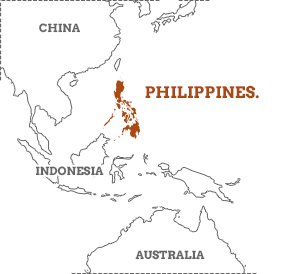

The Philippines’ isolated location means it is ignored by Southeast Asia’s tourist crowds, but with its coral reefs, traditional culture and stunning beaches, that won’t be the case much longer.![]()

Organised holidays to the Philippines make navigating between islands simple. Hike around natural amphitheatres created by ancient rice terraces, and meet the villagers whose ancestors created them centuries ago. Take a bamboo bike tour around Manila’s historic walled centre, and cruise between islets on a snorkel safari, which lets you float over shallow, colourful reefs. Our Philippines travel guide reveals just why it’s worth flying just that bit further, to explore this fascinating, multicultural archipelago.

The Philippines is...
the same size as Italy (by land area), but it has the fifth longest coastline in the world.
The Philippines isn’t...
dangerous. Like many countries, it has its shady areas – but with over 7,600 islands, it’s certainly not difficult to get well away from them.
Things to do in the Philippines...

Philippines small group tour, 13 days
Focusing on Luzon, the largest island of the archipelago.
From
£2395 to £2915
13 days
ex flights

Philippines small group tours
Join our Philippines adventure holiday
From
£3135 to £3495
16 days
ex flights

Philippines holiday, small group adventure
Discover the little visited Philippines gems.
From
£4495
15 days
ex flights

Philippines holiday, 16 days
Experience the very best of the Philippines
From
£5950
16 days
inc UK flights

Philippines Island tour, explorer
13 or 17 days of adventure in tropical paradise
From
£1649
17 days
ex flights

Taiwan to Phillippines small ship cruise
Sail through Philippines secluded islands on a small ship
From
£7400 to £10999
17 days
ex flights


Contact Us
Call us for a chat about our holidays. We are happy to discuss your holiday and help in any way we can. No bots, queues or awful hold music.

01273 823 700
Call us until 6pm
Calling from outside the UK

Things not to do in the Philippines...
More Philippines articles

Read our month by month guide to discover the best time to go to the Philippines.

The best Philippines small group tours are those that avoid foreign-owned resorts and touristy Boracay.

Discover the best snorkelling sites, and when to go, with our guide to snorkel safaris in the Philippines.


Thousands of islands means chances to really go off the beaten track.


