Bosnia-Herzegovina travel guide

Bosnia and Herzegovina is often abbreviated to BiH which, if you pronounce it in English, isn’t exactly an inspiring acronym. But this country is far from being a bit ‘BiH’. In fact the secrets that it conceals from the world of mass tourism hype, such as the Dinaric Alps, limestone lakes and waterfalls, Ottoman architecture and ancient hilltop villages, are the complete opposite to ‘BiH’. More like ‘hell yeah’. Because that’s what you will shout when you climb to the top of Maglic, the Durmitor Mountains’ highest peak. Or when you watch local divers plummet off Mostar Bridge, a famous symbol of peace and reconciliation. Or finish a hike in Sutjeska National Park with a swim in a deserted mountain lake. Or snowshoe through the deserted Bjelašnica Mountains.
Taking the train from Sarajevo to Mostar was way up there with some of Switzerland chocolate box treats. Following the Neretva River, with the Dinaric Alps in the background pure Balkan beauty.
For these reasons, plus the fact that you will receive a right royal welcome in this country that still gets relatively few tourists, we prefer the literal translation of Bosnia-Herzegovina. Welcome to the Princedom of Bosnia.
Read on in our Bosnia-Herzegovina travel guide.
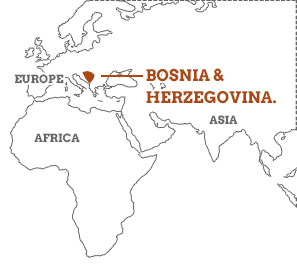
Bosnia-Herzegovina is...

mountainous: snowy in winter and snowshoeing heaven. Sunny in summer, hello hiking.

Bosnia-Herzegovina isn't...

luxurious. It’s real people leading real lives in really impressive landscapes. For chichi (and crowds) head to Croatia.

Things to do in Bosnia-Herzegovina...

A mountainous country with ranges such as the Bjelašnica and Durmitor Mountains, both part of the Dinaric Alps, Bosnia and Herzegovina proffers plentiful walking holidays and almost empty hiking trails compared with the rest of Europe. Its rugged karst limestone landscapes are havens for waterfalls and turquoise lakes, so always pack a swimsuit in your backpack. As well as walking poles and strong boots. Peaks such as the country’s highest, Maglic Mountain (2,386m) in Sutjeska National Park are not just a walk in the park. You get serious snow here, sometimes for five or six months of the year and, although it is not exactly famous for the skiing frenzy that hits the Alps or Pyrenees, it is worth remembering that Sarajevo hosted the Winter Olympic Games in 1984. The iconic mountain of these games was Bjelasnica and, unknown to most, there are superb snowshoeing trails here, such as to Visocica Mountain and Crveni Kuk Peak (1733m) Once the centre of the Ottoman Empire, and with medieval history pouring out of its capital cities, mountain villages, places of worship and local storytellers’ weighty canons, many people include neighbouring Montenegro, Croatia and Serbia on cultural trips to this region. Creating a tailor made itinerary with an expert tour operator is the perfect way to, say, combine coast with culture, peaks with peachy places to stay.

Contact Us

Responsible Travel, Travel Team

Call us for a chat about our holidays. We are happy to discuss your holiday and help in any way we can. No bots, queues or awful hold music.

Responsible Travel, Travel Team

Things not to do in Bosnia-Herzegovina...

Don’t be too fussy. This is not Croatia – it hasn’t ever had a flurry of five star tourism. Bosnia and Herzegovina is still emerging slowly into the world of tourism and is, in many ways, all the better for it. It is still a very rural culture, with many people working in subsistence agriculture. So go slowly, respect local people and their cultures and don’t go looking for Moet in the mountains.
Don’t overlook the fact that this is a mountainous country and that hiking, skiing or snowshoeing here requires expertise and skill. Unless you are travelling with an expert mountain guide, and we recommend that you do, not just for safety but because it is a wonderful way to employ local people in a sustainable way, then take all precautions necessary.
Be sensitive about ethnicity and read up on the conflicts of the 1990s before you go. The three main ethnicities are Bosnian Serb who are mostly Orthodox, the predominantly Roman Catholic Bosnian Croats, and Muslims who are known as Bosniaks. And when you are in the Herzegovina section of the country, be careful about simply describing the country as Bosnia.
Written by Catherine Mack
Photo credits: [Page banner: Hanze] [Is/isn't: Bartlomiej Mostek] [Things to do: Erwan Martin]