Syria travel guide
Syria is resilient. Home of one of the oldest civilisations in the world, it continues to be spectacular, even in the face of the civil war that started in 2011, and in the aftermath of 2022’s devastating earthquake. The country is renowned for the hospitality of its people, the beauty of its cities, the pleasures of Levantine cuisine, and the wealth of its hundreds of archaeological sites – to which more discoveries are added all the time.

Syria’s story has many volumes – fitting for a country with one of the world’s oldest libraries. There have been some dark chapters in recent years, but the country is ready to turn the page.![]()

Its history looms large – to the north are enormous crusader castles, whilst, in its desert oasis, Palmyra, a city made rich by the Silk Road, still stands as a symbol of the country’s endurance. Here’s another: The Norias of Hama – a series of 17 medieval waterwheels, some over 17 metres tall, which lift water out of the Orontes River. It was on Syria’s rich plains that civilisations first started to farm. Modern droughts threaten to take that all away again: the fate of the nation keeps turning, but the country stands strong.

Syria is…
a country where every city has its own specialty dessert.
Syria isn’t…
destroyed by civil war.
Things to do in Syria…

Syria holiday, ancient wonders
Welcome to Syria, ancient and modern
From
€845 to €1850
7 days
ex flights

Syria guided history and cultural tour
Ancient cities, crusader castles and the ruins of Palmyra
From
£2649 to £2999
10 days
ex flights

Syria tour, tailor made culture
Explore ancient sites and historic cities
From
US $1300 to US $2550
10 days
ex flights


Contact Us

Call us for a chat about our holidays. We are happy to discuss your holiday and help in any way we can. No bots, queues or awful hold music.

01273 823 700
Call us until 6pm
Calling from outside the UK


Things not to do in Syria…
Understanding Syria’s geography
Syria’s diversity of sites is no accident. Rami Nawaya from our specialist local partner, Syrian Guides, explains, “Syria is such a strategic place – it’s between three main continents and located on the Mediterranean Sea – you could even think of Syria as China’s harbour on the Mediterranean… but Syria is an open field – it’s not protected naturally from north, east, south, west, it’s open and that’s why it’s very challenging to control.”Because of this, the country has been occupied by many of the big-name empires in world history: the Greek, Roman and Byzantine empires were followed by Arabic rule in the Middle Ages – though sections of the country were held by European crusaders until Mamluk role. The Ottomans invaded in the 16th century and their presence was felt until World War I.
“Various ethnic and religious groups took shelter in Syria over its history, enriching the country. It’s why we have a very colourful society,” says Rami.
More Syria articles

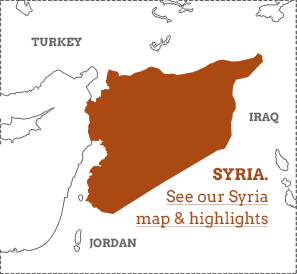
From Damascus to Palmyra, Hama to Krak de Chevaliers, find out the best places to go in Syria with our useful map and list of highlights.


