Paraguay travel guide

Little Paraguay quietly slumbers between South American giants, but it was not always such a tranquil nation. Following independence from Spain in 1811 it bounced from dictatorship to ghastly dictatorship and fought brutal wars against all its neighbours, losing a third of its territory and over half of its population in the process. Since 1989, however, Paraguay has been at peace, and has topped recent polls for the world’s happiest country – on more than one occasion.
Paraguay is the only Latin American nation with an indigenous language – Guaraní – which is widely spoken by non-indigenous people. It’s as if, after centuries of conflict, it is claiming back its rich identity.
Modern visitors to Paraguay will follow in the footsteps of historic ones: Spanish explorers and Jesuit missionaries, whose legacies have shaped the country’s culture and landscapes. Over half of Paraguay is covered by the Chaco, home to a mix of environments from wetland to savannah, as well as South America’s largest dry forest. Although ranchers and loggers are scarring this landscape, it still provides a home for hundreds of species of birds and mammals, over a dozen indigenous groups, and German-speaking Russian Mennonites. This country may be under the radar, but – as our Paraguay travel guide explains – it is far from predictable.

Paraguay is...

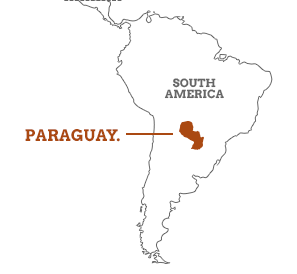
a South American anomaly, with no Andes, Amazon or coastline.

Paraguay isn’t...

on the ‘Gringo Trail’. Come and hang out with gauchos and Guaranís instead.

Things to do in Paraguay...

They may have been expelled in the 1760s, but the Jesuits still have the power to convert: their ruined missions, known as reductions, continue to lure travellers to Paraguay to admire their gorgeous Spanish-Moorish inspired architecture, intricately carved churches and colonnaded plazas. Follow the Ruta Jesuítica through cattle country to towns such as Yaguarón, with its pretty Franciscan church, and Santa María de Fe, whose museum houses dozens of wooden statues which the Guaraní were taught to carve by the Jesuits. Bring your binoculars. And your bird book. The Chaco covers over half of Paraguay with landscapes ranging from wetlands and dry forest to cattle ranches and cacti-dotted plains. Wildlife is abundant, including pumas, tapirs and armadillos, although in this vast landscape, it’s hard to spot. You’ll have better luck with the birdlife; some 500 species inhabit the Chaco, including the ostrich-like rhea, crowned eagles, roseate spoonbills and – from April to October – flamingos fleeing the Chilean winter. It’s no Rio, Buenos Aires or Cuzco, but that is all part of Asunción’s appeal. The Paraguayan capital was founded in 1537, and its inhabitants are enjoying their newfound peace and freedom since brutal dictator Alfredo Stroessner was overthrown in 1989. Crumbling colonial buildings are being restored, the thriving municipal market sells everything from vegetables and counterfeit clothes to herbal medicine, and trucks at the nightly food market serve up Paraguayan beef and Sajonia craft beer. Discover the city’s darker side at the Museo de las Memorias, housed in what was the detention and torture centre during the Stroessner years.

Our top trip

Paraguay tour

Paraguay tour

Ancient Jesuit missions and the remote Chaco region

From £2825 to £2999 12 days ex flights
Small group travel:
2026: 2 May, 22 Aug
2027: 1 May, 21 Aug

Contact Us

Responsible Travel, Travel Team

Call us for a chat about our holidays. We are happy to discuss your holiday and help in any way we can. No bots, queues or awful hold music.

Responsible Travel, Travel Team

Things not  to do in Paraguay...

Expect everyone to speak Spanish. Paraguay is the only South American country with an indigenous language as one of its official languages; Guaraní is spoken by some 90 percent of the population, including many non indigenous Paraguayans. Most people do, of course, also speak Spanish, but learning a few words in Guaraní will really enhance your experience. We admit it’s not easy though – the morning greeting is Mba'eichapa ndepyhareve? In addition, over a dozen other native languages are spoken here, and in the Chaco town of Filadelfia you’ll find a clutch of blond-haired, blue-eyed, High German-speaking inhabitants – descendants of Russian Mennonites. Attempt the Trans Chaco Highway alone. Things have improved a lot since ‘the world’s worst road’ was paved in 2007, before which its swampy conditions snagged vehicles for days on end. However, the 800km long ‘highway’, aka National Route 9 from Asunción to Bolivia, remains fraught with dangers, as gaping potholes rip through the asphalt and lorries churn up dust, drastically reducing visibility. Travelling at night is best avoided, and as much of the road passes few communities and is traversed by just a handful of vehicles, a breakdown can be disastrous. Best travel here with an experienced driver and bring plenty of supplies, even then. Spend your whole holiday in Paraguay. The ‘heart of South America’ combines well with regional overland tours, as a convenient bridge between Argentina and Bolivia. Even if you are focusing on Paraguay, it’s still worth hopping over the Argentinean border to Iguazu Falls – an easy drive from Asunción.
Written by Vicki Brown
Photo credits: [Page banner: Nath Planas] [Is/Isn't: Arcadiuš] [Things to do in Paraguay: mali maeder]