Suriname travel guide

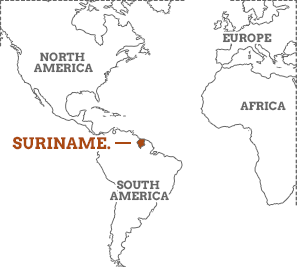
One of the three Guianas, Suriname was once known as Dutch Guiana, and is sandwiched between (formerly British) Guyana to the west, and French Guiana to the east. Though they are all distinct in feel, all three countries share the same geography of near impenetrable Amazon rainforest. Suriname’s interior is home to Maroon villages (descendants of Africans who escaped from slavery) and Indigenous settlements, and travelling here means a mix of road and canoe transport.
Descendants of enslaved African workers, European colonists, and Indian, Indonesian and Chinese indentured labourers all contribute to Suriname’s vibrant culture today.
Suriname’s main habitations hug the coast. Here, you’ll find the dynamic capital, Paramaribo, where the country’s melting pot population finds glorious expression, in its handsome Dutch architecture, its temples, mosques and churches standing happily side by side, and in the spicy Indian and South East Asian food that makes Suriname the best place to eat in the Guianas. Travelling here feels adventurous and although many would struggle to find Suriname on the map, those that make it here find heaps to enjoy.

Suriname is…

Deliciously diverse – and proud of it, with a vibrant capital city where cultures, cuisines and faiths mingle happily.

Suriname isn’t…

Big. It’s South America’s smallest country, covered mostly in rainforest.

Things to do in Suriname…

You can eat really well in Suriname, and particularly in its capital Paramaribo. The diverse ethnic mix of its people has created a vibrant foodie scene, with a wide variety of cuisines served here, including lots of spicy Indian and Southeast Asian influenced food – the legacy of the thousands of indentured labourers shipped here from the Dutch East Indies to work in the sugar cane plantations. Tuck into roti, an Indian grilled flatbread with meat or veg, fried plantain dipped in peanut sauce (bakbana), Indonesian fried rice (nasi), noodles and the Suriname staple, peanut soup. Head inland and meet the Maroons. While French Guiana’s interior is almost impossible to penetrate, Suriname has more accessible rainforest, reached via a canoe from Atjoni. Here you can meet the Maroons, the descendants of slaves who escaped and recreated an African way of life in the heart of the rainforest, unobserved, for centuries. Many Maroon villages now have lodges, ranging from luxurious to basic. Come with a sense of adventure. Suriname is not on any established tourist trail and infrastructure is sketchy here. Be ready to disconnect from the modern world, expect lengthy road journeys on often bumpy roads and carry cash not cards, as ATMs are few and far between.

Our top trip

Hidden Guianas guided tour

Hidden Guianas guided tour

Discover the mysteries of Guyana, Suriname & French Guiana

From £7750 15 days ex flights
Small group travel:
2026: 31 Jan, 28 Feb, 19 Sep, 14 Nov

Contact Us
Responsible Travel, Travel Team

Call us for a chat about our holidays. We are happy to discuss your holiday and help in any way we can. No bots, queues or awful hold music.

Responsible Travel, Travel Team

Things not to do in Suriname...

Brush up on your Spanish or Portuguese. Suriname’s colonial history means Dutch is the national language here. This is just one of the many ways that all three Guianas don’t behave like your typical South American destination. An ethnic mishmash of Amerindians, European colonists, the ancestors of escaped African slaves and descendents of Asian indentured labourers is unique, and the north coast geography means that the culture in the Guianas is more Caribbean than South American. Try to go it alone. Independent travel is really tricky here, with poor infrastructure and very few tourists. Joining a small group organised tour, which will generally take in all the Guianas and perhaps Brazil, too, is the best way to visit Suriname. Logistics, accommodation and excursions are all organised for you, and you’ll have the support of a guide who can speak the various languages of this region. Bring sterling into Suriname – it can’t be exchanged. If you bring currency with you, bring US dollars or Euros. Go to bed too early. Paramaribo has a happening nightlife, with clubs bouncing until the small hours from Wednesday through to Sunday, casinos everywhere and the chance to drink with the locals at outdoor stalls near Platte Brug on the Waterkant.
Written by Joanna Simmons
Photo credits: [Page banner: Jan Hazevoet] [Is/Isn't: Rob Oo] [Things to do: -JvL-]