Venezuela travel guide
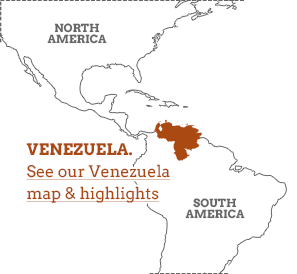
Venezuela is one of the finest destinations for wildlife watching in all of South America. Anacondas, capybaras, pumas and jaguars can be spotted on the Llanos plain; the rainforest is home to giant anteaters, howler monkeys and sloths, and up in the Andes, conservationists are fighting to save condors and spectacled bears.

Like an intrepid adventurer who never knows when to quit, Venezuela is now hauling itself back onto the tourism map.![]()

If you only followed the headlines, or cautious government guidance, Venezuela would probably strike you as a risky country to visit. But our holidays are organised by hugely experienced teams with superb on-the-ground knowledge. They connect you not only with fantastic local wildlife guides, but also Venezuela’s warm and welcoming people.
Plan your own trip with our Venezuela travel guide – you’d be Caracas not to.
Plan your own trip with our Venezuela travel guide – you’d be Caracas not to.

Venezuela is…
a spectacularly beautiful haven of biodiversity.
Venezuela isn’t…
as unstable as news headlines would have you believe.
What we rate & what we don’t
Underrated
Spending locally
Venezuela suffers from soaring inflation which has led to high unemployment, shortages of essentials, and a migration crisis. Take any necessities such as medication with you; don’t count on it being available in-country. Our partners use locally owned hotels and restaurants wherever possible, ensuring that as much income as possible stays in communities that really benefit from it.
Expert guides
There’s no one better at showing you around a community than people who live there themselves. Our holidays work with local guides, who are also experts at tracking down wildlife. Often, they’ll have spent years studying the finest locations for watching birds, reptiles, and amphibians. Some of our guides are researchers, who earn by leading tours, and then invest that money into their studies.
Cheese
Tequenos are fried breaded cheese sticks that are enjoyed as a popular street snack around Venezuela. But mouthwatering though they are, they’re far from the pinnacle of Venezuelan cheesemaking. Fresh white cheeses abound, resembling layered mozzarella and often accompanying meals. Harder cheeses, typically saltier, are also common and good for grating over dishes.
Rated
Wildlife
Venezuela is one of the most biologically diverse countries in the world. The plains of the Llanos region are known as ‘the Serengeti of South America’, conservationists protect condors and spectacled bears in the Andes, tarantulas and rare tree frogs inhabit steamy cloud forests, and every region of the country teems with birds.
Angel Falls
Yes, it’s the biggest tourism destination in Venezuela, and Angel Falls completely deserves its reputation. The tallest uninterrupted waterfall in the world (979m), tumbling down Auyán-tepui mountain, is a breathtaking spectacle. Eschew the boat trips in favour of reaching the base of the falls by canoe through the rainforest and pausing to take a spectacular swim in the lagoon.
Rocking up to Los Roques
This divine archipelago, just north of Caracas, is composed of some 50 islands, as well as hundreds of islets and cays, all strung around a central lagoon. A national park, it protects a coral reef teeming with colourful marine life that enthralls snorkellers and scuba divers. Already checking the swimsuit situation? Can’t say we blame you.
Overrated
Climbing Mount Roraima
Mount Roraima in the Pacaraima Mountains is sacred to the local Pemon people. Viewing it purely as a challenge to be conquered without considering its cultural significance is not on. If you do want to climb or hike it, ensure you spend time (and money) in the communities around the base.
Believing the headlines
Years of economic and political upheaval have taken a heavy toll on Venezuela. Our partners work with hugely experienced local teams to organise their holidays, who know what areas to visit, and which to avoid, so you can travel in confidence.
Oil spills
The tragic death of a well-known flamingo nicknamed Vitico following an oil spill came to symbolise Venezuela’s problems with oil infrastructure that is poorly funded and badly maintained. In just one year, the Venezuelan Observatory for Political Ecology tracked almost 90 spills around the country. One of them polluted Lake Maracaibo so badly that many local fishermen were forced out of business.

Venezuela wildlife holiday
Join experts and track down Green Anacondas in Venezuela
From
£1895 to £2575
10 days
ex flights

Venezuela nature tour
Incredible landscapes, wildlife watching, white sand beaches
From
£5499 to £5799
11 days
ex flights

Venezuela birding tour, tailor made
Explore Venezuela in search of 1,398 species of birds here!
From
£2995
13 days
ex flights


Contact Us
Call us for a chat about our holidays. We are happy to discuss your holiday and help in any way we can. No bots, queues or awful hold music.

01273 823 700
Call us until 6pm
Calling from outside the UK

Food, shopping & people
Eating & drinking
Venezuelan cuisine has strong African and European influences. Cachitos resemble croissants or the kind of pastries you’d find in a Portuguese delicatessen. Arepas, stuffed buns made from maize, are a popular street food – the reina pepiada (curvy queen) filling is named after a Venezuelan beauty queen.
Regional delicacies include smoked cheese, dulces abrillantados (crystallized guava chunks), and puffed pastries that are popular in the Andean region. On the coast, cocada is a refreshing milkshake made from coconut.
Look out for the national dish, pabellon criollo. This simple meal of rice, beans and shredded beef is often served in three distinct sections that recall the horizontal tricolour of the Venezuelan flag.
Regional delicacies include smoked cheese, dulces abrillantados (crystallized guava chunks), and puffed pastries that are popular in the Andean region. On the coast, cocada is a refreshing milkshake made from coconut.
Look out for the national dish, pabellon criollo. This simple meal of rice, beans and shredded beef is often served in three distinct sections that recall the horizontal tricolour of the Venezuelan flag.
People & language
Venezuela’s diverse population includes the descendants of Spanish colonists and many other Europeans who arrived during the 20th-century oil boom and never left, as well as the descendants of African enslaved people, who the Spaniards forced to work in plantations and mines. Around two percent of the population are indigenous peoples, mostly living in the southern Amazon and Andean regions.Some 50 indigenous languages are spoken in Venezuela, though Spanish is the official language.
Chévere is a wonderfully versatile phrase that you can use in all manner of situations. Essentially, it signifies approval – good, great, nice, cool, great idea, sounds good.
Dar la cola means to give someone a ride. It literally translates to ‘give the tail’ – or the back of the horse.
Arroz con mango means rice and mango, and means a chaotic situation. Using it in conversation sounds pretty chévere.
Gifts & shopping
In the 17th century, during the Spanish colonial era, enslaved African labour meant that Venezuela was the world’s largest cocoa exporter. Today, the intensive labour involved, especially when paired with the ongoing financial crisis, means that the cocoa industry is a tiny fraction of what it once was, but Venezuelan beans are still highly prized among chocolate connoisseurs.Coffee too was farmed through extensive use of slave labour, and while Venezuela legally ended slavery in 1854, reliance on cheap labour continued to be widespread. Venezuela continued to be a top coffee producer into the 20th century, but the industry slumped from the 1930s when the economy pivoted towards oil and mining, with government price manipulation worsening the effects.
Like all large-scale farming, coffee growing can have a detrimental impact on nature. The environmental NGO Provita has a project to save the endangered red siskin by working with coffee producers to promote bird-friendly agroforestry techniques, look out for Birds and Coffee products. You can also ask your guide for advice on coffee to buy that supports independent local growers, and nature.
Handmade woven hammocks are popular gifts and souvenirs from Venezuela, though they’re best suited to those with two trees in their garden back home. They don’t have quite the same aura when strung up in the lounge.
As with most countries, unless you’re sure where something came from, it’s best to avoid anything made from wood, animal or precious stones. Sadly, Venezuela’s precious biodiversity is not always treated with the respect and care it deserves.
A brief history of Venezuela
The indigenous peoples of early Venezuela were often nomadic, though in mountainous areas groups such as the Timoto-Cuica built permanent villages, terraced the hillsides for agriculture, and erected houses of stone and wood. Rock art, some of it up to 2,000 years old and among the largest in the world, can be seen in the state of Amazonas. Indigenous peoples make up almost half the state’s population. The engravings depict animals, people, and cultural rituals, giving a fascinating insight into the lives and beliefs of those who left their mark.In 1498, when Christopher Columbus landed in Venezuela during his third voyage to the Americas, he wrote to his sponsors Ferdinand and Isabella, the King and Queen of Spain, that he had found heaven on Earth. Not long afterwards, the Spanish invaded and began a brutal process of conquest and colonisation. Because as everyone knows, nothing quite says paradise like suffering, bloodshed and exploitation. Read more
More Venezuela articles

Learn the best time to go to Venezuela, covering climate, festivals, and need-to-know questions.


Spectacled bears, toads that can’t hop, and a bird that went missing for 60 years - our guide to Venezuela's amazing wildlife and where to see it.


.JPG)


.jpg)