Burkina Faso travel guide

What’s in a name? In Burkina Faso’s case – an awful lot. Charismatic former president Thomas Sankara created the name Burkina Faso in the 1980s, discarding the colonial, and distinctly less interesting, title of Upper Volta. In doing so, he brought several tribes together: the word Burkina comes from the Mossi language, Faso from Diouala. The country’s people are known as Burkinabé – the 'bé' is from the Foufoulde language.
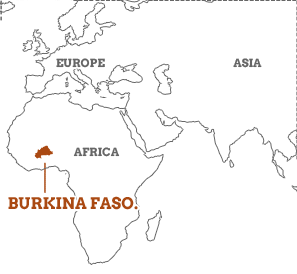
A forgotten country surrounded by a sea of sand, the lack of visitors to Burkina Faso means it remains largely untouched by the outside world – leaving its culture to thrive, undisturbed.
Together, the words mean 'land of the honest people', and while this refers to the truthfulness of the Burkinabé, it could also describe their integrity when it comes to their identity. Burkina Faso has not yet been swept up by capitalism, globalisation and Westernisation; while this has no doubt contributed to it being one of the world's poorest countries, it also means Burkinabé culture is indescribably rich. Most famous are the vibrant mask dances, during which performers enter a spiritual trance induced by hypnotic percussion. But there are also mud mosques, Tuareg traders, an extraordinary music and cinema scene, thousand-year-old ruins and remote communities following animistic beliefs. Discover this little-explored nation in our Burkina Faso travel guide.

Burkina Faso is...

looking towards a brighter future, after its first democratic election in 2015.

Burkina Faso isn't...

urbanised. Over three quarters of Burkinabés still live in rural areas.

Things to do in Burkina Faso

Troupes from across West Africa gather in Dedougou every two years to participate in Burkina Faso’s most vibrant celebration, FESTIMA (The Festival of Masks and the Arts) complete with dancing wooden masks, pounding percussion, storytelling contests and market stalls. As well as the impressive wooden masks, which represent animals and spirits, costumes can be made of grass, colourful fabrics, leaves and raffia, making for a hypnotic, swirling spectacle. The footwork is incredible! West Africa is rarely associated with wildlife – but that’s all the more reason to enjoy it when you can. Nazinga Game Reserve is no Serengeti – but within its compact boundaries are around 800 elephants – as well as monkeys warthogs and 500 buffalo, and knowing you’re one of very few visitors ever to set foot here makes it all the more special. What’s more, income derived from tourism deters local villagers from poaching, and ensures the protection of this reserve. Explore the culture. Burkina Faso is a brilliant mix of tradition and modernity. To the north, nomadic Tuaregs trade with Bella merchants, crossing the desert with camels as they have done for centuries; in the south, exquisite mud villages appear to rise up from the earth. Traditional music – wooden marimbas, the calabash-based kora – is still widely played, but in the music capital of Bobo-Dioulassou, it is fused with more modern sounds, and the live performances are not to be missed. Ouagadougou is the capital of African film, with government support for local filmmakers, and theatre is both contemporary and participatory – a uniquely Burkinabé experience.

Our top trip

Burkina Faso & Mali holidays

Burkina Faso & Mali holidays

Experience the magic Mali and Burkina landscapes and people

From €3480 15 days ex flights
Tailor made:
Arrival on a Saturday throughout the year

Contact Us
Responsible Travel, Travel Team

Call us for a chat about our holidays. We are happy to discuss your holiday and help in any way we can. No bots, queues or awful hold music.

Responsible Travel, Travel Team

Things not to do in Burkina Faso...

Pack skimpy clothes. It may be close to 40 degrees – but Burkina Faso is a conservative country and you should be covered from shoulders to knees, at a minimum. It’s a great idea to carry a light scarf/pashmina for throwing around your shoulders – it’ll keep the sun off, too.
Hand out cash. Burkina Faso is one of the poorest countries in the world, but indiscriminately handing out money or gifts is not the answer – it encourages begging and harassment of tourists, and can cause resentment in communities. Speak to your tour company and ask what you can bring or where you can donate – village elders or head teachers, for example, can then distribute items and money where it is most beneficial. Even better, buy items locally, such as clothes, books or pencils - that way you're supporting local traders and producers, too.
Get up close to hippos. Though many Burkinabé believe they are sacred and therefore unlikely to attack humans, they’re still one of the most deadly creatures in Africa. Keep well away.
Go with the asking price. Haggling is an intrinsic part of life here, so head into the markets and barter like a Burkinabé. Ignore the warnings. Burkina Faso has long been a safe and peaceful nation, but its northern neighbours are passing through turbulent times. The FCO periodically warns against travel to the Sahel region due to issues in Mali – your tour company will keep up to date with any developments, and know which areas are safe to visit. Be aware that FCO travel warnings can invalidate your travel insurance; your holiday company will offer advice on this.
Written by Vicki Brown
Photo credits: [Page banner: Marco Fumasoni] [Is/isn't: Jeff Attaway] [Things to do: Marco Fumasoni]