Burundi travel guide

Standing in a semi-circle on a hilltop with their sacred instruments before them, Burundi’s royal drummers perform their mesmerising set to a select few. They dance, perform acrobatics and wink at the crowd, drumming to ward off evil and to bring good omens. This is your dramatic welcome into the ‘heart of Africa’, a green, hilly land with remarkable wetlands, where the long, lovely shore of Lake Tanganika attracts East Africans looking for a weekend on the beach.
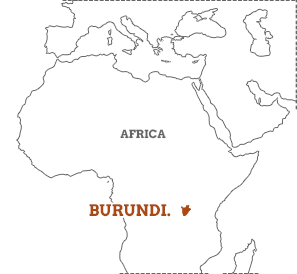
A traditional Burundi greeting in Kirundi is ‘amashyo’ – it means ‘may you have many herds of cattle’.
Burundi is one of the poorest countries in the world, beset by years of instability, civil war and authoritarian rulers. Most of the country ekes out a living in subsistence farming. But recent years have welcomed a relative peace. Burundi is surrounded by neighbours who have successfully attracted tourism – Rwanda, Uganda, Tanzania. Travellers would be privileged to share in the country’s culture, but for now, the drummers perform to a very small audience.

Read our Burundi travel guide for more details.

Burundi is…

a small player among the giants of Africa’s Great Lakes region.

Burundi isn’t…

on the tourist map.

Things to do in Burundi…

Enjoy nature. National parks in Burundi are small and don’t have the gorillas and lions of their neighbours, but the landscape is lusciously green and there are magnificent wetland areas. One of Burundi’s best sights is the Chutes de la Karera – a six-branched, three-level series of five fantastic waterfalls, where the main drop is 80m high. Then there’s the Nyakazu Fault – also known as the Germans’ Gorge – a long, rocky tract filled with forest, with fantastic views over the Tanzanian plain from its top. Buy traditional crafts. Burundi’s basketry art form is threatened by the increasing use of plastic containers, but it’s representative of Burundi’s rich craft culture. To make the lidded baskets, women gather long strands of sweetgrass together, and wrap them tight in thin strips of colourful fibre that come from unravelled grain sacks. These form bonded ropes of different colours that can be coiled to make baskets and neat matching lids. Stop at craft shops in Bujumbura to pick yours out. Go with a guide who can help you interpret the country’s culture, much of which exists in oral tradition. In Bujumbura you could go on a tour led by local women to find out how people really live in different suburbs of the city. Consider giving back. Burundi can be a country that is hard to visit without wanting to offer ongoing support. There is mass unemployment, widespread malnutrition, and climate change is making both drought and flooding more common, threatening the country’s already terrible food security. Some of our partners have set up charitable arms so that they can directly support Burundi; they can help you direct your support, too.

Our top trip

Burundi holiday

Burundi holiday

A cultural journey through the heart of Africa

From £2345 8 days ex flights
Small group travel:
2026: 7 Jan, 8 Jul
2027: 6 Jan, 7 Jul

Contact Us

Responsible Travel, Travel Team

Call us for a chat about our holidays. We are happy to discuss your holiday and help in any way we can. No bots, queues or awful hold music.

Responsible Travel, Travel Team

Things not to do in Burundi…

Miss the drumming. The karyenda (‘sacred drum’) is used during important occasions in Burundi. The drummers also perform for tourists – and around the world – and the drumming has been inscribed on UNESCO’s Intangible Cultural Heritage list. You’ll need to reserve your spot at the royal hill of Gishora in advance. Expect to speak English. Burundians are united in their use of Kirundi, which is spoken by all three main population groups, the Hutu (who make up 85 percent of the population), Tutsi (14 percent) and Twa (1 percent) peoples. French is also spoken – a result of its period under Belgian colonial rule in the 20th century. In some areas you may be able to get by with a bit of Swahili or English, but it’s no guarantee. Travelling with a local guide can help you overcome any language barriers. Visit the zoo. We don’t advertise trips that include zoos – let alone zoos with captive chimpanzees, crocodiles and leopards, that let visitors feed live guinea pigs to the exhibits. Skim-read health and safety warnings. Travel can be difficult in Burundi for a variety of reasons, including changing security situations and poor infrastructure, and there’s little health provision outside of Bujumbura. Getting around Burundi can be challenging. You’ll be driving on unpaved roads, navigating frequent and often unofficial roadblocks. Go as part of an organised tour to ensure you’re in safe hands.
Written by Eloise Barker
Photo credits: [Page banner: Dave Proffer] [Is/Isn't: Christine Vaufrey]