Cameroon travel guide

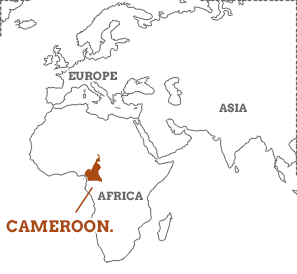
Cameroon prides itself on being “all of Africa in one country”. This may seem like a bold statement, but it might just be true. Within its varied terrain – spanning rainforest, mountains, savannah, coastline and desert – there are around 250 ethnicities. These include several tribes such as the nomadic Fulani, and the Koma – who hid in the mountains from the outside world until the 1980s. French and English are both official languages, and Islam and Christianity are both widespread – as are traditional animistic religions. Then there is the wildlife, including elephants, monkeys and 690 species of birds. And of course – there are lowland gorillas and chimpanzees.
Is there anything in Africa that you won’t find in Cameroon? Well – tourists, for one.
Despite appearing to 'have it all', you won’t find clusters of safari vehicles, or lodges packed out at peak time. You won’t find modern cities or smooth roads either – but the logistical challenges this absence presents just makes a holiday in Cameroon all the more immersive. Find out more in our Cameroon travel guide.

Cameroon is...

full of variety in its landscapes, languages and ethnic groups.

Cameroon isn't...

on the tourist trail yet – despite its wealth of attractions.

Things to do in Cameroon

Though Cameroon’s gorillas and chimpanzees can be seen in the wild, your best bet is the excellent sanctuaries that battle the bushmeat trade. Limbé is the best known, but they can also be seen in large enclosures at Mfou Primate Sanctuary in Mefou National Park. Pongo Songo, a reserve, specialises in rescuing baby chimps, who are fostered by the older chimp residents. They live without enclosures on an island. Reintroduction into the wild is, sadly, rarely possible – so closer interaction with humans may be permitted.Spend time with tribes. With 250 ethnic groups, you’ll never meet all of Cameroon's peoples – but the Ring Road is a good start, linking numerous small kingdoms, traditional villages and artisan workshops. In the Mandara Mountains, the Koma are some of Cameroon’s most fascinating people. Having fled here to escape colonial and tribal invasions, they remained unknown to outsiders until the 1980s. The Fulani are elegant and striking – nomadic cattle herders of North African origin, who you’ll likely encounter on your Cameroon travels.Jim O’Brien, from our Cameroon specialist Native Eye, recommends staying in a hunter-gatherer village: “I stayed in a village near Kribi and went out into the forest with them, and collected honey. They’re very marginalised, they don’t really play much part in mainstream society unfortunately. The people are really, really friendly and they like to have a drink and party, which is quite interesting! You get more accepted the longer you stay with them.”

Our top trip

Cameroon holiday, Tribal lands

Cameroon holiday, Tribal lands

Discover some of Central Africa's most fascinating cultures

From £4699 to £4799 12 days ex flights
Small group travel:
2026: 4 Nov
2027: 2 Nov

Contact Us

Responsible Travel, Travel Team

Call us for a chat about our holidays. We are happy to discuss your holiday and help in any way we can. No bots, queues or awful hold music.

Responsible Travel, Travel Team

Things not to do in Cameroon...

Ignore the plight of the Baka people. The Baka have been displaced from their native forests by conservation projects, which assume that people cannot live sustainably alongside forest ecosystems – despite the fact that the Baka have done so for millennia. If they hunt to feed their families, they risk being shot by anti-poaching squads. Survival International explains more here. The term ‘pygmy’, which has been used to describe several Central African hunter-gatherer tribes, is considered pejorative by the tribes themselves, such as the Baka people, who prefer to be known by their tribe’s name.
Buy bushmeat. We always encourage travellers to experience local cuisine, but we do draw the line at encouraging poaching – especially of endangered species. The scale of the trade here is quite shocking, with tentative steps having been taken to regulate it – but monkeys, pythons, porcupine and pangolin are a common sight in markets – with bigger primates occasionally making it to the table, too. Don’t support it – and avoid souvenirs made from animal parts, too.
Give inappropriate gifts. Responsible tour companies will compensate traditional communities, like the Koma people, for hosting travellers – but these payments are well thought out in order to complement their traditional lifestyles. Items such as sugar and tea can be given to the elders, who can share it out amongst villagers; cash, clothing, sweets and pens may well be inappropriate tokens. While we have no issue with traditional communities adopting more modern ways of life, we do think they should be able to do it on their own terms, without it being thrust upon them through tourism.
Written by Vicki Brown
Photo credits: [Page banner: canonim] [Is/isn't: James Emery] [Things to do: Magicc0077]