Central African Republic travel guide

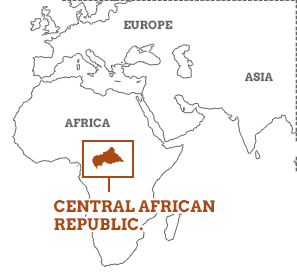
The Central African Republic is very little-visited; even its ongoing conflicts receive little coverage in the foreign press. Travelling here is a tricky business; tourism – or indeed any – infrastructure is scarce. Foreign Office warnings abound, and then there is the question of what to do here; any search for ‘Central African Republic’ pulls up news reports and encyclopaedias, not travel guides. But, of course, there is lots to experience in the CAR.
The Central African Republic shelters forest elephants and lowland gorillas in huge numbers – which you can observe without another tourist in sight.
It is home to the Ba’aka, the original people of the forest, who can share with you their traditional hunting and gathering skills and millennia-old knowledge. And as you sit on a viewing platform at the Dzanga Bai, gazing at hundreds of elephants, buffalo, antelope and hogs snuffling about in the mineral rich earth, this troubled nation may just feel like the most peaceful place on earth. Find out more in our Central African Republic travel guide.

CAR is…

still off limits to all but the most intrepid travellers. Organised tours, and proper travel insurance, are essential.

CAR isn’t…

your typical tourist experience. Spend a few days in a world of foraging elephants, lowland gorillas, indigenous forest communities and pristine jungle.

Things to do in CAR…

Gorilla tracking. The dense forests of Central Africa are home to western lowland gorillas; their remote habitat makes it difficult to estimate population numbers, but the highest concentrations are found in southwestern CAR, in the Dzangha-Sangha Reserve. Experienced trackers will enable extraordinary encounters with habituated gorilla families here, and you can spend up to an hour in their company. Meet the Ba’aka.The indigenous people of the Congo rainforest, also known as pygmies, have inhabited this land for millennia. But cast aside all thoughts of a peaceful hunter-gatherer existence; over the centuries the Ba’aka have been enslaved by the Bantu, forced to work in plantations, evicted in the name of conservation, and lost their homes to deforestation. Widespread poaching also means they struggle to hunt enough meat. Today, the Ba’aka tend to lead more settled lives, but retain their extraordinary knowledge of the forest, which acts as their larder, pharmacy and DIY store. Day trips and overnight stays introduce you to this extraordinary culture, with medicinal plant walks and net hunting demonstrations. Tourism is an important source of income for the Ba’aka, who have few sustainable employment opportunities. Combine with a trip to Cameroon. Most CAR tours start out in neighbouring Cameroon, with flights to Yaoundé – typically via France – much more accessible than to Bangui. From there, a two-day drive up to the CAR border lets you spend time with local Ba’aka communities, and stop off at small forest towns along the way, easing you into Central Africa.

Our top trip

Central African Republic wildlife holiday

Central African Republic wildlife holiday

Track gorillas and explore the forests of Central Africa

From £4759 to £4999 10 days ex flights
Small group travel:
2026: 23 Feb
2027: 22 Feb

Contact Us

Responsible Travel, Travel Team

Call us for a chat about our holidays. We are happy to discuss your holiday and help in any way we can. No bots, queues or awful hold music.

Responsible Travel, Travel Team

Things not  to do in CAR…

Travel independently. Visiting the Central African Republic is intrepid enough without attempting to do it under your own steam. There is widespread unrest, and thoroughly unreliable road and transport options. Experienced tour operators understand the situation on the ground and work closely with local guide and communities to ensure you are safe and comfortable. The relationships they have built up here mean you can visit Ba’aka villages, and they’ll also know the best places and times to seek out the diverse wildlife. Both small group and tailor made tours are available. Assume you can speak English here. Or even French. While French is the official language of CAR, it is estimated that less than a quarter of Central Africans speak it, and fewer outside the cities. The closest thing to a lingua franca here is Sango, spoken as a first or second language by around 80 percent of the population. Focus on the gorillas. They may be the Dzanga-Ndoki National Park’s most famous inhabitants, but this area protects an extraordinary wealth of wildlife. Head to Dzanga Bai to see huge elephant herds frolicking in the mineral rich mud of the forest clearing. Spend a day tracking mangabeys, living in troops sometimes number over 150, or take night walks in search of wide-eyed nocturnal forest dwellers, from owls and galagos (bush babies) to pottos and pangolins.
Written by Vicki Brown
Photo credits: [Page banner: hdptcar] [Is/isn't: David Holt] [African elephants: cocoparisienne]