Chad travel guide

Gazelles skip over plateaus, rare crocodiles bask in oases, and the Toubou people lead their camel herds to the shade of the rocks to drink. Landlocked Chad is a massive, sparsely populated Sahelian country. Whilst it is arid, it is not unrelentingly so, and life moves with its seasons. Heavy rain in the months of July to October floods the south and east, semi-nomadic peoples steer their livestock towards grazing ground, and the predators in the amazing Zakouma National Park follow their prey.
Some 18 hours’ drive from N’Djamena, Zakouma National Park rejoices in its remoteness. Millions of red-billed quelea form mass murmurations above its slow-moving elephant herds.
Moving northwards through the country, savannah gives way to Sahel, which bleeds into Sahara. Otherworldly limestone pinnacles, sculpted by sand, rise from dunes punctuated by Technicolor lakes and salt pans. There is no traffic, no towns, no electricity and Chad’s populace is dwarfed by the immense landscape. Chad hosts over a million refugees, many from its battle-scarred neighbours. Its border with Libya is land-mined, and the unrest drags on. But what the few, intrepid visitors find here is a rare kind of peace. Discover this country’s hidden soul in our Chad travel guide.
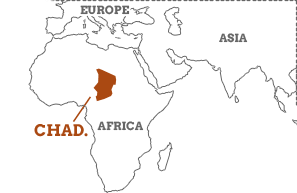
Chad is...

far from a barren desert. Over 200 ethnic groups live here, speaking over 100 languages and dialects.

Chad isn't...

easy. This is an expedition, not a holiday; you’ll be counting the stars above your desert camp, not on your hotel.

Things to do in Chad…

A beauty contest for young men, in which they are painted for the occasion, and must dance, parade, and display their poise, is at the heart of Gerewol Festival. Celebrated by the Wodaabe people in the Durbali region, and taking place in autumn, it's an incredible spectacle, as traditional as ever, with the winner celebrated for years to come – and the women on guard, should another woman choose her husband as the prettiest.The Guelta d’Archei ia a permanent waterhole surrounded by steep cliffs and reached via a trek across the desert lasting between one and a half and two hours. The hike is worth it; from a clifftop viewpoint you can see hundreds of camels being led to the water’s edge as their bellows echo eerily off the rocks.The Tibesti Mountains, tucked into a remote corner of the Sahara between Niger and Libya, are little explored even by African standards – which is part of their mysterious appeal. Historically out of bounds it is now possible to visit – but expect to spend days driving across the desert and nights camping out under the stars to reach these volcanic peaks, home to some of the world’s most remote settlements.

Contact Us

Responsible Travel, Travel Team

Call us for a chat about our holidays. We are happy to discuss your holiday and help in any way we can. No bots, queues or awful hold music.

Responsible Travel, Travel Team

Things not to do in Chad…

Get hammered. Central and northern Chad is largely Islamic – and consuming alcohol is frowned upon – though it’s often ok to drink in the desert villages. If you’re not sure whether to drink or not, it’s very simple – if alcohol is widely available, or offered to you, then bottoms up. If not, don't go looking for it.
Travel without insurance. Many insurance companies won’t cover travellers heading into Chad, due to FCO warnings and instability in the surrounding countries. However, your holiday company will work with those that do, and in an area this remote, and with such sparse medical facilities, it’s incredibly important to have backup in case of an accident.
Expect to meet other travellers. Chad is one of the least explored countries in the world, with great stretches of its desert landscape unvisited even by Chadians, let alone international travellers. One of our tour leaders has spent a total of around ten weeks in Chad – he saw a group of two tourists just once.
Play with the tanks. The remains of old conflicts are littered across the landscape, particularly in the north from the war with Libya, where you’ll come across rusting tanks and jeeps half swallowed by sand. Don’t go near them – there may be unexploded devices waiting to go off.
Written by Vicki Brown
Photo credits: [Page banner: David Stanley] [Is/isnt: Ken Doer] [Things to do: Valerian Guillot]