Democratic Republic of the Congo travel guide

The Democratic Republic of the Congo, in the deep heart of Africa remained uncharted by Europeans until the 1800s, when Belgian King Leopold’s lust for an empire met explorer Henry Morton Stanley’s lust for fame, and the explorer ventured up the Congo River to discover what lay beyond. They ravaged this landscape, using its people as slaves and its forests for rubber, until both were exhausted. The atrocities remained unknown until recently, taking place in a land so remote and inaccessible that they were easily hidden – and even more easily ignored.
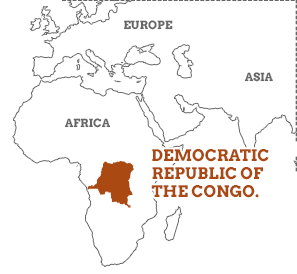
DRC is Africa’s second largest country, a behemoth stretching across the continent from the Atlantic in the west to the gorilla-prowled forests of East Africa.
DRC's cultural and natural wonders – the stunning islands of Lake Kivu, its lava-lake topped volcanoes, the dandy-style sapeurs that stroll the streets of Kinshasa, the wealth of primates that include chimpanzees, bonobos and two species of gorilla - deserve greater recognition. What’s more, tourism here helps conserve these fragile habitats and provides vital income for communities ravaged by conflict. Read on in our DRC travel guide.

DRC is…

home to at least 450 species of mammals, and its eastern forests contain the greatest variety of primate species in the world.

DRC isn’t…

the Republic of Congo, the country just on the other side of the Congo River. You can see the capital, Brazzaville, from DRC’s capital, Kinshasa.

What to do in DRC…

The Democratic Republic of the Congo is primate central. As well as three species of gorillas, there are chimpanzees and bonobos – a chimp-like ape which isn’t found anywhere else in the world. You can track habituated chimps and gorillas here, as well as looking out for dozens of other primate species on river cruises and forest walks, including colobus and vervet monkeys, baboons, mangabeys and bush babies. Nyiragongo is one of the world’s most active volcanoes, and overnight hikes will take you up to its 3,470m peak for astounding views over the surrounding landscape and the town of Goma. But that’s not the most impressive thing you’ll see up here; Nyiragongo’s crater is filled with a bubbling lava lake up to 600m deep that makes the night sky glow red. Stay in a mountain hut on the rim, and awake to the sun rising between Karisimbi and Visoke Volcanoes in the distance. DRC may be virtually landlocked, but there are plenty of opportunities to take to the water. You can cruise the Congo River upstream from Mbandaka to Kisangani, much like the intrepid explorers of old. Dock at villages where, perhaps, westerners have never before set foot, watch daily life pass by on the riverbanks, and gaze into the forest canopy in search of birds and monkeys. Alternatively, head to tranquil Lake Kivu for scenic cruises and island exploration. Idjwi Island in particular is a great place to meet local fishermen and explore traditional villages, or you can paddle a kayak on the calm waters.

Our top trip

Democratic Republic of Congo tour

Democratic Republic of Congo tour

Encounter gorillas, chimps and meet pygmies on Idjwi island.

From £5699 to £5899 14 days ex flights
Small group travel:
2026: 8 Jun
2027: 7 Jun

Contact Us

Responsible Travel, Travel Team

Call us for a chat about our holidays. We are happy to discuss your holiday and help in any way we can. No bots, queues or awful hold music.

Responsible Travel, Travel Team

What not  to do in DRC…

Go it alone. Even explorer Henry Morton Stanley ventured into Congo with an enormous entourage. DRC today may have roads, cosy lodges and anti malarials, but while travelling here is now more comfortable, violence can still flare up at times, even in the national parks. Travel as part of a small group or tailor made tour with a responsible operator who works with local providers and guides, and understands the situation on the ground. Local guides also act as interpreters, know the best places to spot wildlife, and take you into local communities. This is not only the safest way to travel, but also the most enjoyable. It’s easy to assume that seeing gorillas is the thing to do here, but don’t overlook DRC’s incredible biodiversity. DRC is also home to around 40 percent of the world’s chimpanzees; you can track them in Virunga National Park. It the only country where bonobos live; these small, peaceful and highly sociable apes are closely related to chimps – and to humans. Bonobos are tough to see in the wild, but the world’s only bonobo sanctuary exists in Kinshasa. In addition, there are dozens of monkey species in DRC plus almost 1,200 species of birds, which are no less exciting – did you know peacocks originated here? Assume that adventure and relaxation are not compatible. DRC offers an expedition rather than a holiday, and every day will bring something unexpected and exciting, and itineraries are designed with this in mind. With all the adrenaline, efforts have been made to ensure you also have downtime, to laze by lakes, paddle a kayak, wander around chilled local villages, soak up the views, or relax with a book.
Written by Vicki Brown
Photo credits: [Page banner: DFID - UK Department for International Development] [Is/isn't: Satya] [Gorilla monther and child: Ludovic Hirlimmann]