Eritrea travel guide

Saturday morning in Asmara and, after a cappuccino, the city's inhabitants are found cycling down the palm-lined central boulevard, past its dilapidated theatre, the Art Deco cinema, and the Catholic cathedral, and enjoying the cooler temperatures that the high-altitude city affords. Eritrea has the kind of attractions that should pull in visitors: archaeological ruins, beautiful beaches along its long Red Sea coastline, and wildly creative Modernist architecture, much of it built under Mussolini during Italy's occupation.
Asmara’s curious main attractions include a graveyard of tanks, a scrap metal market, and a steam locomotive that runs out of the city and into the mountains.
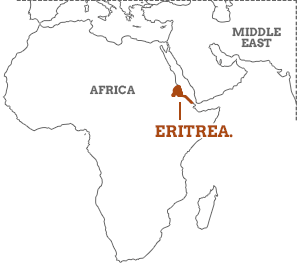
Sadly, though, the country’s recent history has kept it off the map – both literally, and for tourists. Eritrea was an Italian colony from 1896 until World War II, then a province of Ethiopia, which annexed it in the early 1960s, triggering a 30-year war. Eritrea eventually declared independence in 1993, but peace was short-lived and since 1998, tensions have bubbled along the Ethiopian border, with periods of outright war and more than 80,000 people killed. In 2020 Eritrea and Ethiopia became involved in the Tigray War against the Tigray people and a 2022 ceasefire changed little on the ground. Tourism, for now, barely exists beyond the summer visitors from the Eritrean diaspora. Even organised tours are subject to local authority restrictions, limiting travel to just a few towns and sites, some contingent on group size.

Eritrea is…

where Abyssinian landscapes, archeological ruins and colonial Art Deco architecture meet.

Eritrea isn’t…

developed. The infrastructure would benefit from investment, and power sometimes fails, although its roads are fairly decent.

Things to do in Eritrea…

Explore Asmara. Eritrea’s capital city is full of modernist architecture dating from the Italian colonial period. Most of it is Art Deco specifically, designed with more flair and creativity than anything built in Europe during the same period. Stylish cinemas, an opera house and cafes selling espressos and cappuccinos pepper the city centre, while in the suburbs beyond lie chic villas that once belonged to the Italian elite. Go shopping. Monday in Keren is market day, with the weekly camel market a must-see. Shoppers not looking for a new dromedary can haggle for hens, sheep and goats instead. Over on the city’s dried out riverbed you’ll find a produce and household market – a great place to browse. In Asmara there’s a produce market on Saturdays and also Medebar Market, an open-air workshop as much as a shopping destination, where discarded tyres, old furniture and even olive cans from Italy are ingeniously converted into sandals and household kit. Dress modestly, especially in lowland and predominantly Muslim areas, where shorts and T-shirts may draw unwanted attention. Women in particular should keep knees and shoulders covered, unless you’re on the beach in Massawa.

Our top trip

Eritrea tour

Eritrea tour

Small group tour. Eritrea’s unique landscapes and culture

From £3550 10 days ex flights
Small group travel:
2026: 6 Mar, 25 Sep
2027: 5 Mar, 24 Sep

Contact Us
Responsible Travel, Travel Team

Call us for a chat about our holidays. We are happy to discuss your holiday and help in any way we can. No bots, queues or awful hold music.

Responsible Travel, Travel Team

Things not  to do in Eritrea…

Visa applications in the UK are only accepted in person, rather than via post or an agency, so applicants must visit the embassy to lodge their application. The embassy then has to obtain authorisation from Eritrea before it can issue the visa, and this normally takes two to three weeks to come through. So, don’t wait to the last minute to get a visa – it’s important to plan ahead. Although Eritrea has a low crime rate, it does have a very poor record on human rights and a history of detaining anyone who speaks out against the government. Keep your thoughts about the ruling regime to yourself and don’t even think about criticising it, either in public or private, while in Eritrea. Don’t bring your credit card – Eritrea has a cash based economy, and there are no ATM machines anywhere. It’s illegal to use US Dollars to buy anything, except at a few officially recognised hotels, and you’ll need a receipt. The currency in Eritrea is the Nakfa and it isn’t convertible outside Eritrea, so before you leave, change any remaining Nakfa at one of the state recognised ‘Himbol’ exchanges. Currency exchange outside of official channels is illegal. Don’t use your left hand for handshakes, eating or passing something to others. The left hand is thought of as unclean – only the right will do in public.
Written by Joanna Simmons
Photo credits: [Page banner: Matej Hudovernik] [Intro: Voice of Clam] [Things to do in Eritrea: theblacknemesis]