Wild Atlantic Way tours

Brace yourself on one of the many clifftop viewpoints, and you’ll soon discover how Ireland’s Wild Atlantic Way got its name. Ahead, there’s nothing but waves, weather and the occasional whale until you hit North America, roughly 3,500km west. Waves pummel sea cliffs, carving them into caves, arches, stacks and stumps that are a geography geek’s (guilty as charged) dream. When the tide drags out, sea-sanded platforms are the final footprints of where cliffs once stood.

On a windy day on the Wild Atlantic Way, the breeze will either breathe life into you or send you packing to the pub. Here, either is a great option.

“The west coast is fabulous,” says Chris Hendrie. He lives in County Clare – about halfway along the route – and helps design our Wild Atlantic Way rail tours. “There are so many peninsulas and a different flavour to each.”
The west coast is fabulous. There are so many peninsulas and a different flavour to each.
This westerly tourist route follows a coastline created by tectonic forces and the shove of the Atlantic Ocean. Another powerful force shapes the west coast – tourists. The Wild Atlantic Way might sound like an age-old pilgrimage route, but it was christened by the tourist board in 2014. They had a clear mission brief: to encourage some of Dublin’s six million yearly overseas visitors to venture beyond the hallowed halls of Trinity College and the Guinness Storehouse, to the little-visited west coast.

It worked – and really well. Now, over a decade later, over three million international tourists explore the Wild Atlantic Way each year, with two thirds of first-time visitors including it on their itinerary.

Not just for drivers

Most people drive the Wild Atlantic Way (and if you haven’t meandered through the Cork and Kerry mountains with Whisky in the Jar on full blast, have you even been?). However, with more people visiting each year, there’s a fresh challenge: working out how to tour the Wild Atlantic Way responsibly.

Thankfully, our trips are designed thoughtfully from the ground up, leaving you to enjoy the adventure. They might embark in small groups that don’t overwhelm tiny towns or recommend departure dates that avoid adding to the summer traffic jams. In fact, our most popular trips ditch the car for the most part, choosing to explore by train routes, cycling lanes and walking paths that offer different points of view.

Wild Atlantic Way map

What is the Wild Atlantic Way?

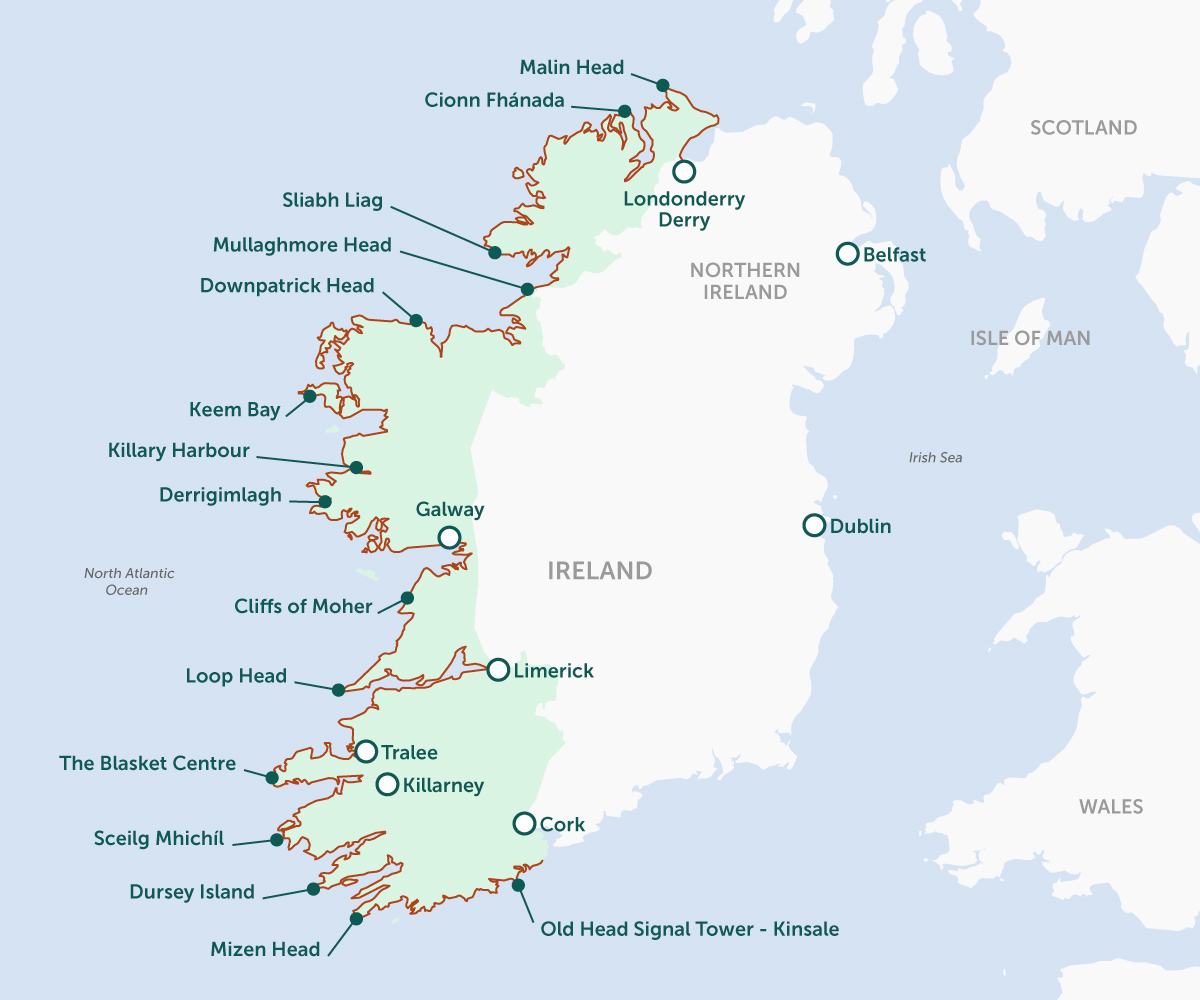
The Wild Atlantic Way is a 2,600km-long tourist route on the west coast of Ireland. It connects County Donegal in the north to County Cork in the south – and you can take your pick of stops along the way.

Contact Us

Responsible Travel, Travel Team

Call us for a chat about our holidays. We are happy to discuss your holiday and help in any way we can. No bots, queues or awful hold music.

Responsible Travel, Travel Team

How to tour the Wild Atlantic Way

Rail routes in Ireland are incredibly easy. It’s more relaxing and scenic than driving.

By train: to Europe’s westernmost rail lines

“Rail routes in Ireland are incredibly easy,” says Chris. “It’s more relaxing and scenic than driving.”

As our Wild Atlantic Way rail tour expert, Chris would know. From his hometown of Ennis, trains run to many of the Wild Atlantic Way cities, as well as to tiny Tralee – the westernmost railway station in Europe. There isn’t a train line along the craggy coast, so the Wild Atlantic Way is the end of the line. “This trip is designed to take advantage of what exists,” says Chris. “Nobody is building new train lines in Ireland.”

Our rail trips begin in Dublin, where direct trains depart for many of the main stations on the Wild Atlantic Way. Guided small group tours head to Galway (2.5 hours away), then on to Ennis, Limerick and back to Dublin. Tailored rail holidays in Ireland give you the chance to consider different routes – perhaps starting with another 2.5-hour train journey to Cork for the nearby harbour town of Kinsale, where a rainbow of houses marks the southern starting point of the Wild Atlantic Way.

The award-winningly-pretty riverside town of Westport, in County Mayo, is three hours away from Dublin by train too. “Westport is one of the most colourful towns in Ireland, packed full of life and painted in really vibrant colours.” says Chris. “County Mayo is my favourite part of the country. Various lochs and mountains… the scenery is fantastic.”

He has a soft spot for his hometown too, which also features on the itinerary. “Ennis has 25,000 people and they have a pub each, pretty much!” says Chris. “You see the coast from here – the Cliffs of Moher. And the Burren – the massive limestone landscape that many people have never heard of… Ennis is a bit off the beaten track… regarded as the heart of Irish traditional music. My wife and her family are all traditional Irish musicians; it’s how many of them make their living. Every pub will have music.”

By bike: with cyclists campaigning for change

John Kennedy is the third-generation owner of our cycling tour specialists West Ireland Cycling. There aren’t many people better placed to run our Wild Atlantic Way cycling holidays. As well as being local experts, they campaign for improved cycling lanes and support alliances of passionate pedallers such as the Galway Greenway, working to transform abandoned railway lines into car-free routes.

“Our cycling tours are all self guided and lead you through the Burren over rural tarmac roads and paved paths – proper winding country lanes, only a car’s width wide,” says John. “Not that you’ll see many cars. Our cyclists really enjoy the good-quality road surfaces and being surrounded by countryside.”

After a day in the saddle, the rests are as important as the routes. Accommodation leans towards small, family-run – often women-run – lodgings that range from port town B&Bs to waterside lodges.

“I’ve known and worked with many of them for decades,” says John. “These women have become great ambassadors for the whole of Ireland, let alone just the west coast.”
Electric car provisions have roared ahead. Or, rather, quietly swished their way ahead.

By electric car: for a low-emission road trip

Want to explore straight down the coast? A car is your best bet. Our tailor made tours combine train with car travel – or you can create your own road trip on our electric self drive holiday. Our partners McKinlay Kidd created the trip to celebrate the 10th birthday of the Wild Atlantic Way – a decade in which electric car provisions have roared ahead. Or, rather, quietly swished their way ahead.

Small distances also mean you don’t have to worry about running out of charge. “Ireland is quite small,” says Chris. “It’s also quite easy to get to know because pretty much everywhere you want to go is on the coast.”

Our itineraries are carefully designed with accommodation that comes with charging facilities. It isn’t a case of any old charging point will do. You’ll stay by silvery loughs in Connemara, at family-owned lodgings in the Burren, and in spa hotels with Atlantic views.

Travelling by car also gives you the chance to explore well off the beaten track. And you don’t have to spend the whole time behind the wheel. Guided walks across the Burren, e-bike adventures, seaweed foraging trips, and kayaking tours can all be sprinkled in – and all led by local guides. They might be able to teach you a few words of Irish while you’re plodding or paddling. The Wild Atlantic Way rolls through some of the last Gaeltacht districts, where Irish is the main language spoken in day-to-day life.

“Our guides are one-man bands,” says Chris. “They have vehicles and they are experts at their particular location… they do this every day. We get incredible feedback about them.”

On foot: walking the other wild ways

Like many long-distance routes, the Wild Atlantic Way is made up of many smaller, older walking routes. Our Dingle Way walking holiday explores one of them, looping around the Dingle Peninsula via standing stones, lonely beaches and oceanside towns. These self guided options give you the chance to stroll between villages and coves at your own pace. Our Kerry Way walking holiday also takes in part of the Wild Atlantic Way, winding from low mountain passes to old textile towns such as Kenmare – now better known for its excellent seafood restaurants.
The Wild Atlantic Way has starred in a string of films and TV series, including The Banshees of Inisherin and Normal People. Star Wars might be the most famous, though.

With camera in hand: on a photography tour

Getting a sense of déjà vu? The dramatic scenery of the Wild Atlantic Way has starred in a string of films and TV series, including The Banshees of Inisherin and Normal People. Star Wars might be the most famous, though: Rey trained with Luke Skywalker on the shard-like island of Skellig Michael in The Force Awakens and The Last Jedi.

You can capture the spectacular scenery for yourself on our photography tours on the Wild Atlantic Way. Flexibility is key in any photography tour – but especially on the west coast of Ireland, where a drizzly “grand soft day” is celebrated. Light, bright rain is in fact something to be thankful for on the changeable coast.

“In terms of the itinerary, you need to be flexible because so much is outside, so the weather affects everything,” says Geraldine Westrupp, co-owner of our specialists Wild Photography Holidays. “People know they can trust our organising and be confident that things will be well put together. Actually, organising things on the fly is one of my favourite things!”

Our partners also know that tourism is a vital source of income for many remote Irish towns – so instead of well-trod places, they take you to viewpoints and villages that welcome fewer people. They also tend to run in late summer and autumn, when the weather is more reliable and the roads are less busy.

“Our travellers range from total beginners to professional photographers and everyone in-between,” says Geraldine. “Everyone is welcome. You can come with just an iPhone, or a full set up, and we work with you from start to finish all the way from showing you the best way to take a photograph to how to develop them professionally.”

Our travellers also ask…

How long is the Wild Atlantic Way?

The Wild Atlantic Way is 2,600km long. If you drove directly along the motorway from point A to B, it’d be more like 500km, but this is called a scenic drive for a reason – the route winds around every peninsula and bay on Ireland’s craggiest coastline.

Where is the Wild Atlantic Way?

The Wild Atlantic Way follows the west coast of Ireland, stopping by cities like Donegal, Sligo, Galway, Limerick and Killarney.

Where does the Wild Atlantic Way start & finish?

The Wild Atlantic Way runs between the Inishowen Peninsula in County Donegal in the north and the harbour town of Kinsale in County Cork in the south. If you start in the north, you’ll begin on the biggest and oldest peninsula in Ireland, treading rocks first formed about 1,750 million years ago. Start in the south-west, meanwhile, and you’ll begin amongst completely different ridge and valley landscapes of red sandstone that first began life on a completely different continent.

What is the best part of the Wild Atlantic Way?

Famous sights like the Cliffs of Moher and Aran Islands are spectacular and popular, but often the best parts of the Wild Atlantic Way lie off the beaten track. Galway is great for catching Irish music, but so is Ennis – and the pubs are less busy. The Aran Islands are always worth a visit – and everyone knows it. Take the boat to Sherkin for similarly beautiful views complete with a lighthouse and an artist colony.

How long do you need to do the Wild Atlantic Way?

Technically, you could drive the Wild Atlantic Way in a (very long) day – but where’s the fun in that? Our holidays usually take a week to explore, slowing down to soak up the scenery and spending time in places that people usually speed through.

Can you do the Wild Atlantic Way without a car?

Yes! We have cycling, walking and train trips that explore the Wild Atlantic Way.
Photo credits: [Page banner: Courtesy Failte Ireland] [Intro: K. Mitch Hodge] [By bike: Xavier von Erlach] [On foot: Courtesy Failte Ireland] [What is the best part of the Wild Atlantic Way?: Courtesy Failte Ireland]