Wildlife in Venezuela
In Caracas, the Venezuelan capital, there are hundreds of brightly coloured macaws flying around. Many of them are former pets, freed from cages, and now a regular sight on tourist balconies come the cocktail hour, hoping to share your bowl of complimentary peanuts.
Venezuela is a ‘megadiverse’ country, home to very high levels of biodiversity across rainforest, mountain, coastal, riverine and urban habitats. The macaws of Caracas might be some of the easiest wildlife to spot, but with the help of expert local guides on our Venezuela wildlife tours you can thrill in some truly spectacular sightings.
Venezuela is a ‘megadiverse’ country, home to very high levels of biodiversity across rainforest, mountain, coastal, riverine and urban habitats. The macaws of Caracas might be some of the easiest wildlife to spot, but with the help of expert local guides on our Venezuela wildlife tours you can thrill in some truly spectacular sightings.

Macaws are now a regular sight on tourist balconies come the cocktail hour, hoping to share your bowl of complimentary peanuts.![]()

Responsible wildlife holidays are badly needed in Venezuela. Years of economic and political turmoil have stunted efforts to protect and restore nature. The main issue is the fragmentation and destruction of habitats, driven by deforestation, urbanisation and agriculture. But there are myriad other threats to wildlife, from hunting and trafficking to the overexploitation of natural resources, and pollution such as that resulting from illegal gold mining in the Venezuelan Amazon.
Another barrier to effective conservation is a lack of funding for research. That makes it difficult to even know what species Venezuela has, and where and in what numbers.
Another barrier to effective conservation is a lack of funding for research. That makes it difficult to even know what species Venezuela has, and where and in what numbers.
How tourism is operated is very important. It must always be done in the most responsible and conscious way.![]()
“Income from wildlife tourism benefits local people,” says Juan Carlos Amlibia. Juan is an Amazon specialist at Provita, a Venezuelan environmental NGO, as well as a biologist and tour guide. “This encourages communities to protect habitats and reject illegal activities that harm animals. And it also helps to fund conservation projects.
“How tourism is operated is very important. It must always be done in the most responsible and conscious way, following the principles of ‘leave no trace’.”
Our wildlife holidays help researchers by sharing detailed information on sightings, allowing them to make more informed studies. Researchers often fund their work by acting as guides for tours. Their knowledge of behaviours, threats and unusual facts adds a great deal of colour to the experience.
Other trips – especially our birdwatching tours in Venezuela – work with professional zoologists, naturalists and ornithologists to give you the best possible chance of sightings. Combined with a network of guides across Venezuela who know where to find the most elusive and rare species, these are reliably successful expeditions that also deliver substantial benefits to the wildlife they are tracking down.
“How tourism is operated is very important. It must always be done in the most responsible and conscious way, following the principles of ‘leave no trace’.”
Our wildlife holidays help researchers by sharing detailed information on sightings, allowing them to make more informed studies. Researchers often fund their work by acting as guides for tours. Their knowledge of behaviours, threats and unusual facts adds a great deal of colour to the experience.
Other trips – especially our birdwatching tours in Venezuela – work with professional zoologists, naturalists and ornithologists to give you the best possible chance of sightings. Combined with a network of guides across Venezuela who know where to find the most elusive and rare species, these are reliably successful expeditions that also deliver substantial benefits to the wildlife they are tracking down.

Where to see wildlife in Venezuela

Venezuela wildlife holiday
Join experts and track down Green Anacondas in Venezuela
From
£1895 to £2575
10 days
ex flights

Venezuela birding tour, tailor made
Explore Venezuela in search of 1,398 species of birds here!
From
£2995
13 days
ex flights

Venezuela nature tour
Incredible landscapes, wildlife watching, white sand beaches
From
£5499 to £5799
11 days
ex flights


Contact Us

Call us for a chat about our holidays. We are happy to discuss your holiday and help in any way we can. No bots, queues or awful hold music.

01273 823 700
Call us until 6pm
Calling from outside the UK


Safaris & ranch stays
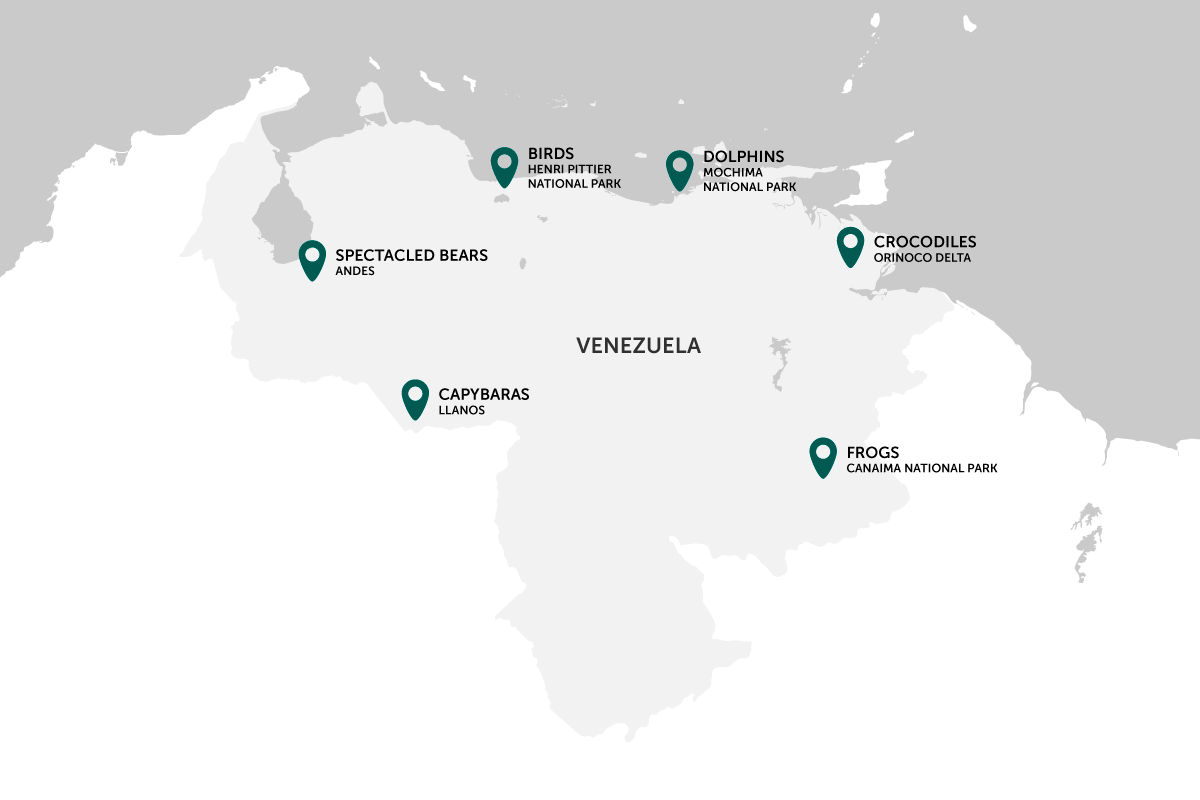
The vast Llanos region is a mosaic of open grasslands and wetlands threaded with rivers, ponds and lakes that routinely flood during the rainy season (May to October). The wildlife here is prolific and incredibly varied. You can see everything from endangered Orinoco crocodiles to anacondas, spectacled caimans, giant river otters, pink river dolphins, and several species of freshwater turtle such as the knobbly-shelled mata mata. On land there are tapirs, capybaras, geckos and giant anteaters, and if you’re amazingly lucky you might catch sight of a jaguar or a puma.On our Venezuela wildlife watching tours that visit the Llanos you will often stay on a working cattle ranch, from which tours by jeep and boat depart. Your stay is also an opportunity to learn about gaucho (cowboy) culture – Stetsons optional.
Bird watching
Venezuela is an absolute paradise for birdwatchers. Particularly noteworthy destinations on our bird watching holidays here include Henri Pittier National Park with its coastal landscapes and cloud forest, where you can see some 580 species, many of which are endangered.
“Henri Pittier is ideal for bird watching, particularly around the Rancho Grande biological station,” says Juan. “There is also a great diversity of reptiles and amphibians, and some mammals such as different species of monkey. It is an excellent place to see birds mainly, but it is not well-developed for tourism, with a lack of facilities and walking trails.”
Many thousands of birds can be seen in the Llanos, especially in the dry season (November to April) when wildlife clusters around pools and riversides. Raptor species on display here includes turkey vultures, ospreys, ornate hawk-eagles, and lesser yellow-headed vultures. If you don’t come home with a stuffed sightings book, there might be something wrong with your binoculars.
Andean cloud forests harbour astonishing diversity too, and more than a few surprises. The Tachira antpitta is a tiny brown bird that was first recorded by scientists in the 1950s, but then disappeared until a group of researchers found it in 2016. The bird lives in thick undergrowth and is hard to spot, but the team were able to identify it by its song – they knew they were on the right track because it was the only one they heard that they didn’t recognise.
Working with the British charity Woodland Trust, the Venezuelan NGO Provita has helped save the yellow-shouldered parrot which is threatened with extinction across the Caribbean region, by buying a conservation area on an island called Margarita, off the Macanao Peninsula. Local volunteers now patrol the area, protecting the birds and their nests, and managing reforestation efforts. The parrot population has more than doubled since 1989.
Birdwatching tours through swamps, grasslands, and forests feature guided walks by day and night, the latter using spotlights. Itineraries can be created bespoke if you have particular destinations or species in mind, and to make the most of your time you will be out in the field for hours every day – rest days are only included on request.
“Henri Pittier is ideal for bird watching, particularly around the Rancho Grande biological station,” says Juan. “There is also a great diversity of reptiles and amphibians, and some mammals such as different species of monkey. It is an excellent place to see birds mainly, but it is not well-developed for tourism, with a lack of facilities and walking trails.”
Many thousands of birds can be seen in the Llanos, especially in the dry season (November to April) when wildlife clusters around pools and riversides. Raptor species on display here includes turkey vultures, ospreys, ornate hawk-eagles, and lesser yellow-headed vultures. If you don’t come home with a stuffed sightings book, there might be something wrong with your binoculars.
Andean cloud forests harbour astonishing diversity too, and more than a few surprises. The Tachira antpitta is a tiny brown bird that was first recorded by scientists in the 1950s, but then disappeared until a group of researchers found it in 2016. The bird lives in thick undergrowth and is hard to spot, but the team were able to identify it by its song – they knew they were on the right track because it was the only one they heard that they didn’t recognise.
Working with the British charity Woodland Trust, the Venezuelan NGO Provita has helped save the yellow-shouldered parrot which is threatened with extinction across the Caribbean region, by buying a conservation area on an island called Margarita, off the Macanao Peninsula. Local volunteers now patrol the area, protecting the birds and their nests, and managing reforestation efforts. The parrot population has more than doubled since 1989.
Birdwatching tours through swamps, grasslands, and forests feature guided walks by day and night, the latter using spotlights. Itineraries can be created bespoke if you have particular destinations or species in mind, and to make the most of your time you will be out in the field for hours every day – rest days are only included on request.
Tepui trekking
Canaima National Park, in the Venezuelan Amazon, was created to protect some 50 flat-topped mountains that are known as tepuis. In the language of the local Pemon people, tepui means ‘houses of the gods’. These mountains, which contain some of the oldest rock on the planet, are riddled with caves harbouring insects and bacteria. And on their summits, cut off from the world by steep cliffs up to 3,000m high, are flora and fauna that have been able to evolve in near-total isolation for millions of years.
The tepuis are difficult to access, except by helicopter or climbing. But multi-day treks can take you up a few of the tepuis such as Mount Roraima or Auyan (Angel Falls flows over its edge). On the lower slopes of the mountains there are mammals including monkeys, sloths, pumas and jaguars, as well as snakes, lizards and bats. But it’s at the summits where researchers and conservationists focus most of their attention, on plants and animals that may not be found anywhere else on Earth.
The tepuis are difficult to access, except by helicopter or climbing. But multi-day treks can take you up a few of the tepuis such as Mount Roraima or Auyan (Angel Falls flows over its edge). On the lower slopes of the mountains there are mammals including monkeys, sloths, pumas and jaguars, as well as snakes, lizards and bats. But it’s at the summits where researchers and conservationists focus most of their attention, on plants and animals that may not be found anywhere else on Earth.
There are frogs that spend their entire lives inside cavernous carnivorous plants here, and toads that can’t hop, but instead scrunch up into balls and roll away to escape predators.![]()
“In terms of wildlife watching the tepuis are not that attractive,” says Juan Carlos, “because it is not easy to see the fauna with the naked eye. Sometimes you must have a specialised guide for this and even then it may be a matter of luck.”
Ironically, however, the isolation that has protected these species for so long is now their greatest threat, because in the face of a warming climate they have nowhere to retreat. Of particular concern are the many amphibian species on the tepuis, which are cold-blooded and so more vulnerable to changes in temperature than mammals or birds.
The Pemon people believe that the tepuis are sacred and should be off-limits to the living, but trekking up them is allowed. Responsible tourism is essential in these incredibly fragile and important ‘biodiversity lifeboats’ because it is currently unregulated or policed. Delicate habitats have been trampled by hikers, minerals dug up for souvenirs, and there are frequent incidents of off-roading in the wider national park.
Ironically, however, the isolation that has protected these species for so long is now their greatest threat, because in the face of a warming climate they have nowhere to retreat. Of particular concern are the many amphibian species on the tepuis, which are cold-blooded and so more vulnerable to changes in temperature than mammals or birds.
The Pemon people believe that the tepuis are sacred and should be off-limits to the living, but trekking up them is allowed. Responsible tourism is essential in these incredibly fragile and important ‘biodiversity lifeboats’ because it is currently unregulated or policed. Delicate habitats have been trampled by hikers, minerals dug up for souvenirs, and there are frequent incidents of off-roading in the wider national park.
They are like islands and their organisms have adapted in a very specific way to survive there… This is the only place in the world where they exist.![]()
“These ecosystems are very fragile,” continues Juan Carlos. “They are like islands and their organisms have adapted in a very specific way to survive there, so they are sensitive to any change that can alter the dynamics. There are species that are in danger of extinction, although in most cases it is because they are small populations. This is the only place in the world where they exist.”
Yet tourism is a more palatable alternative to what some intend: illegal gold mining has been reported on a few of the tepuis. In recent years there was a mysterious fire on Mount Roraima – one theory is that it was set to clear land.
“There is clear evidence of environmental degradation due to mining in the Venezuelan Amazon, and it is easily observable in satellite images,” says Juan Carlos. “If this continues and adequate actions are not taken, this may not mean a good future for this region.”
Yet tourism is a more palatable alternative to what some intend: illegal gold mining has been reported on a few of the tepuis. In recent years there was a mysterious fire on Mount Roraima – one theory is that it was set to clear land.
“There is clear evidence of environmental degradation due to mining in the Venezuelan Amazon, and it is easily observable in satellite images,” says Juan Carlos. “If this continues and adequate actions are not taken, this may not mean a good future for this region.”
Condor conservation in the Andes
High up in the Andes, a team of researchers works at the Mifafi biological station to reintroduce the condor to Venezuela. As scavengers, condors are valuable to an ecosystem as they feed on carcasses, helping to keep wildlife populations healthy and prevent the spread of disease. They are often shot or poisoned by livestock farmers, and guano harvesters who fear the condors will scare away seabirds, whose poop they sell for fertiliser.
Habitat loss is the key threat, however, and Andean condors share their mountainous habitat with another endangered species, the spectacled bear. Bears are in rapid decline in Venezuela, as they are in many other parts of South America – poaching for meat or medicinal remedies is a big contributor. Paddington Bear, the accident-prone, sandwich-addicted hero of children’s literature, is an Andean bear, though he hails from Peru. The biggest threat to his existence is walking under a London bus.
You would be immensely lucky to spot either a bear or a condor in the wild, but some of our tours do visit the biological station where you can learn about the vital work being done, and perhaps make an individual donation if you wish.
Habitat loss is the key threat, however, and Andean condors share their mountainous habitat with another endangered species, the spectacled bear. Bears are in rapid decline in Venezuela, as they are in many other parts of South America – poaching for meat or medicinal remedies is a big contributor. Paddington Bear, the accident-prone, sandwich-addicted hero of children’s literature, is an Andean bear, though he hails from Peru. The biggest threat to his existence is walking under a London bus.
You would be immensely lucky to spot either a bear or a condor in the wild, but some of our tours do visit the biological station where you can learn about the vital work being done, and perhaps make an individual donation if you wish.
Snorkelling & scuba diving
Some of our wildlife watching holidays offer an optional extension of a few days in the Los Roques archipelago, 160km north of Caracas. There are 300 or so islands here with white sand beaches and clear waters perfect for snorkelling and diving with marine life including turtles. The birdlife includes herons, pelicans and brown boobies.
Pelicans and dolphins can be seen in Mochima National Park. The park, with its stunning setting between mountains and sea, is severely threatened by human encroachment – sliced up by a highway and a gas pipeline, these landscapes are being primed for premium tourism. Yet the park is technically off-limits to development, and environmental impact assessments seem to be ignored. It’s another area where respectful, responsible tourism can show the way to more sustainable uses of natural landscapes.
Pelicans and dolphins can be seen in Mochima National Park. The park, with its stunning setting between mountains and sea, is severely threatened by human encroachment – sliced up by a highway and a gas pipeline, these landscapes are being primed for premium tourism. Yet the park is technically off-limits to development, and environmental impact assessments seem to be ignored. It’s another area where respectful, responsible tourism can show the way to more sustainable uses of natural landscapes.
More Venezuela articles

Our Venezuela travel guide has everything you need to know about a beautiful, biodiverse and welcoming country.

Learn the best time to go to Venezuela, covering climate, festivals, and need-to-know questions.


_at_Colca_Canyon.jpg)