Our timeline
1999: Responsible Travel begins
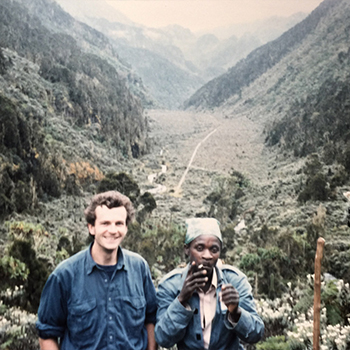
Responsible Travel begins
Responsible Travel started life as a research project for our founder, Justin, during his MSc in Tourism, Conservation and Sustainable Development at the University of Greenwich in 1999. It was a response to how the tourism industry had been packaging up ‘paradise’ for sale with little regard for local people or environmental impact, as well as Justin’s childhood experiences of the negative impacts of tourism in his hometown of Bath. Justin’s solo journeys through Africa later in life ignited his imagination for a different type of travel.
Maximising the benefits of travel
Working with his course tutor and co-founder, Professor Harold Goodwin, Justin developed a plan to change the tourism industry by defining and naming an alternative type of travel that focused on the responsibility to support the places and people we visit. They applied an academic approach that aimed to maximise the benefits of tourism to local people and places while reducing negative impacts and openly sharing the results.
They called this approach ‘Responsible Travel’.
The first responsible tourism business
The company was registered on 4 January 2000 and began operations on 4 April 2001. At that time, we were one of the first online travel companies and the first responsible tourism business in the world, defined by our name and with policies supporting our ambitions. Within the industry, the combination of travel and social and environmental responsibility was initially met with scepticism. Today we are the largest responsible tourism business by number of trips, offering more than 6,000 on our site.
Early 2000s: social responsibility
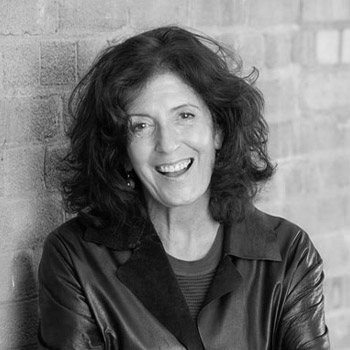
We joined a small but significant cohort of companies putting social responsibility at the centre of their business. Our first seed investor was Dame Anita Roddick, founder of The Body Shop and widely regarded as a pioneer of ethical business since the 1970s. Justin had worked with Anita before founding Responsible Travel.
Independently owned
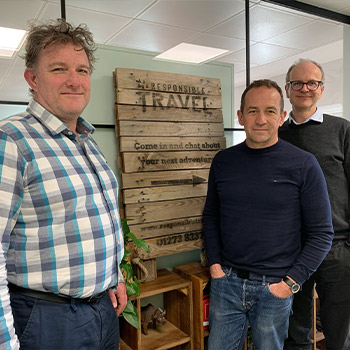
Having rejected many approaches, and bought out a minority private equity investor, Responsible Travel decided to remain an independent business, majority owned by Justin Francis and its joint managing directors, Richard Skinner and Tim Williamson. This allowed us to keep to our ambitious founding purpose: to ‘create a new category of travel’ within the tourism industry, free from the commercial pressures that can come from some investors. Our aim was to show that everyone has a choice about how to travel and to be the threat of good example.
A unique business model
Under the traditional travel agent model, travellers talk to a representative who tries to select a holiday for them, sometimes with limited knowledge of the destination or holiday. We believed that the best way to provide expert, tailored advice was to cut out the middleman and connect our customers directly with handpicked partners – part of a carefully screened network of holiday operators based around the world who run the trips.
The way we make money is also unique. Commission is collected from our tour operator partners on an honesty-based system, through which over £200 million of sales have now passed. The success of this relies on trust and shared ambitions with our partners.
Our screening process
From the start we introduced a screening process for our potential partners to ensure they meet our criteria for responsible travel.
- We screen every partner and every holiday against our criteria for responsible travel. Evidence is presented to customers on each of the 6,000 holiday pages.
- Our process of screening and improving the impacts of our holidays is unique, being the only travel company in the world to include its customers in the process. Customers who book are asked to review their experience and whether the stated responsible travel policies were met.
- Reviews are published in full on holiday pages so that future customers can see them and shared with the supplier to help them improve both the experience and the impact on local people and tourism destinations.
Leading & influencing
In 2001 only two tour operators in the UK had documented policies for their environmental or social impacts. Since then we’ve helped 1,295 tour operators develop responsible travel policies and holidays, and we have screened 22,665 trips – more than any other business – before offering them to our customers.

2002 – 2009: Standing up for change
Trustee of The Travel Foundation
From 2003 to 2007 Justin was appointed as a Trustee of The Travel Foundation, an organisation dedicated to improving the benefits of tourism globally.
The Responsible Tourism Awards
In 2004 Responsible Travel founded The Responsible Tourism Awards – the first award scheme for responsible travel – to celebrate the best achievements by tour operators, accommodation owners and destination managers globally.
Twenty years later, Justin remains a judge, and Harold Goodwin chairs and runs the awards.
Responsible Travel & carbon
In 2002 Responsible Travel became the first travel company in the world to offer its customers a carbon offset scheme, reflecting a growing customer consciousness regarding climate change and air travel. This initiative was rapidly adopted throughout the industry, and beyond.
In 2009 we decided that the evidence for offsets was flawed and dropped them from our holidays. The New York Times covered our decision, quoting our argument that offsets served ‘as a dangerous distraction from the more important task of reducing our emissions’.
Since 2009 we’ve been the only travel company to advocate to governments (and customers) for a reduction in travel by air until we can decarbonise aviation.
Investing in our team
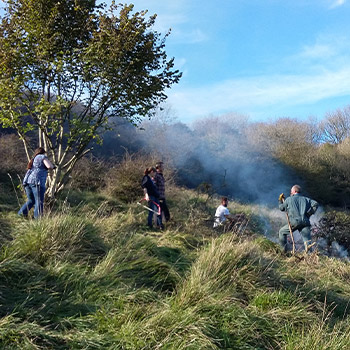
We decided to invest in the people who make our business work. From our early days we have offered an annual profit share, giving our employees 10 percent of our profits. We also provide a half-day of paid time per month to volunteer in the community or for nature and organise two additional conservation volunteering days a year within our local area. To date this has included clearing woods to create space for nightingales, creating a path at a local beauty spot, and building a pond for wildlife in a popular public park. Over 30 percent of our employees have been with the company for 10 years or more.
An activist travel company
From the outset we’ve endeavoured to stand up for what we believe in. The Guardian described Justin as ‘the great activist traveller’ and referred to us as ‘the first place to look for environmentally friendly holidays’. The New York Times described us as ‘a great source of ideas by a spokesperson for responsible tourism’.
For the past 23 years we’ve run campaigns targeting issues in our industry and been one of the loudest voices holding it to account.
In many cases we were early advocates for issues that have been subject to real change. For example, we led the charge against captive whales and dolphins in 2014, when whale shows were still a mainstay of package tour itineraries. A resort keeping orcas in a concrete tank threatened to sue us, and the PR of a mass tourism company told us he’d ensure we never worked in travel again.
Our campaigns have covered a wide range of topics, including:
- Mass tourism, all-inclusive tourism and cruise ships
- Accessible travel
- Carbon offsets
- Evaluation of the carbon impact of holidays
- Aviation taxation and regulation
- Artificial snow in ski resorts
- Sustainable tourism accreditation schemes
- Tourism and poverty alleviation
- Elephant riding for tourists
- Cetaceans in captivity
- Whaling in Iceland
- Turtle hatcheries
- Volunteering and canned lion hunting
- Orphanage tourism
- Volunteering dos and don’ts
- Tourism boycotts (including Burma)
- LGBTQ+
- Greenwashing
- Porters’ rights
- Tourism taxation
- Community based tourism
- Zoos

Early social media
In 2007, soon after Facebook and three years before Instagram arrived, Responsible Travel launched a social networking site for travellers called IKnowaGreatPlace.com. We were among the first to recognise the role social media would play in travel, and the site generated significant interest, particularly for photo sharing. We couldn’t compete with the emerging social media giants and chose to close it once they began to dominate the market.
We have also voiced concerns about the impact of social media on travel. The New York Times quote of the day, 29 August 2018, was: ‘Seventy-five years ago, tourism was about experience seeking. Now it’s about using photography and social media to build a personal brand.’ – Justin Francis
2010 – 2019: Growth and advocacy
Our Land
From 2011 to 2016 Responsible Travel partnered with the Government and 16 national parks and Areas of Outstanding Natural Beauty in the UK to create a travel site called Our Land (in homage to Woody Guthrie’s song ‘This Land is Your Land’). This platform promoted holidays that supported conservation and experiences in nature within these protected areas.
Honest travel guides
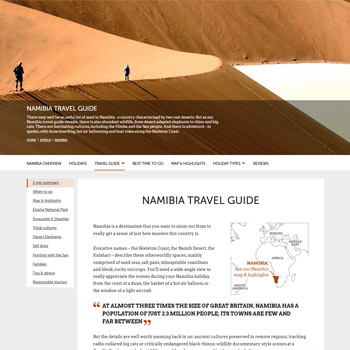
In 2013 we began publishing travel guides to destinations. From the start we aimed to be as honest as possible – if somewhere was a bit rubbish, we said so. This at times made us unpopular with tourist boards. Each guide included tips for responsible tourism in that destination. We now have over 650 guides. By 2023 they had received 18 million page views, and the Responsible Travel site had 56 million visitors.
Trip for a Trip
In 2017 we launched our Trip for a Trip scheme. For every holiday booked by a customer, we fund and organise a day out to a visitor attraction for a child from a disadvantaged background.
Michael Palin praised the initiative: ‘Trip for a Trip sounds like an excellent idea. My appetite for travel began with day trips, so I know how much they can mean to a child. Good luck to all that can make this happen.’
To date, over 7,000 children from the UK, Romania, Laos, Pakistan, Uganda, Brazil and other countries have benefited from Trip for a Trip.
No more zoo visits
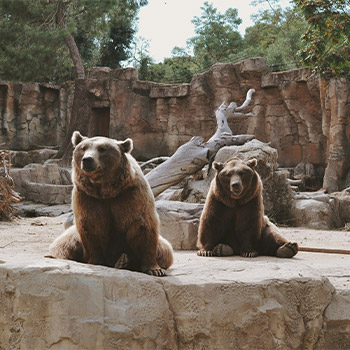
In 2017 Responsible Travel became the first travel company to drop zoos from our itineraries. We argued that most creatures held in captivity in zoos are neither from threatened species nor successfully reintroduced to the wild.
Zoos provide the wrong type of educational experience for children and offer far less funding for conservation than customers expect. We retained legitimate animal sanctuaries, rescue centres and endangered species conservation centres, and continue to monitor their credibility.
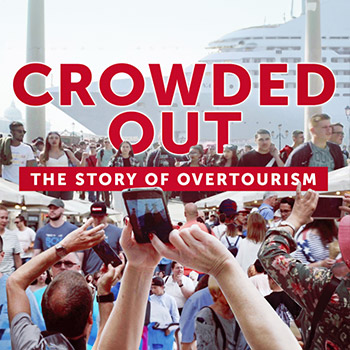
Crowded Out
In 2018 we made Crowded Out, the first documentary about overtourism. It has now been viewed over 500,000 times across different platforms and shown at film festivals and residents’ meetings in tourism destinations around the world. We have given hundreds of interviews for global media, offering our insights and solutions to this issue.
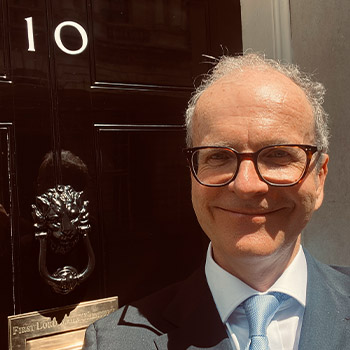
Justin becomes advisor to UK Government
In 2018 Justin was invited to serve as an advisor to the UK Government’s Secretary of State for Environment, Food and Rural Affairs, as Nature Lead at the Council for Sustainable Business. He currently chairs a digital platform called Projects for Nature, which raises money for nature projects in England.
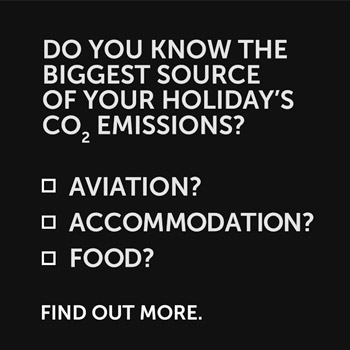
Reducing the carbon emissions of our holidays
In 2019 we commissioned a groundbreaking study into the carbon footprint of our holidays. As a part of this study, we identified that the food we choose to eat and the source of energy used in accommodation make up a significant part of the carbon emissions of our holidays, alongside transport emissions, which is typically the biggest contributor.
Our work to reduce carbon includes a 16-point plan of actions with our partners to reduce carbon and restore nature (which is vital for sequestering carbon). We have also labelled 850 holidays with their carbon emissions and send customers a pre-departure film on how to ‘curb your carbon’, including the message to ‘stay longer and fly less’.
While we believe in taking personal responsibility for our emissions, we also think that aviation’s emissions are too lightly regulated. In 2019 Responsible Travel published recommendations for how Governments could address aviation’s rapidly growing carbon emissions through a Green Flying Duty.
2019 – today: A change of purpose and record profits
6000 trips
By 2021 we had 6,000 trips, including over 10,000 accommodation options. We offered travel to 160 countries and more than 1,000 national parks and World Heritage Sites – some of the most fragile and important places for carbon sequestration and biodiversity on the planet.
Our purpose
The concept of responsible travel and tourism firmly established, we intensified our focus on the climate and nature crisis and changed our purpose:
To inspire travellers to discover our beautiful and fragile planet, to restore nature and reduce carbon, and to be honest about our limitations while striving to be more inclusive.
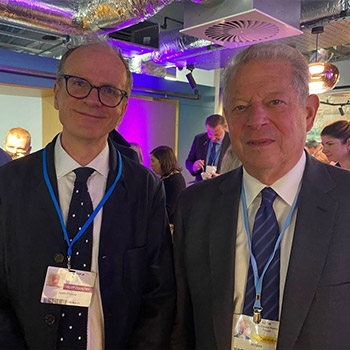
Nature positive
At COP26 in November 2021, Justin and the Council for Sustainable Business led a summit on nature with the UK Government, where Al Gore (author of An Inconvenient Truth and former US Vice President) spoke. During this summit, Responsible Travel became the first travel company to set a nature positive goal. ‘Nature positive’, which subsequently became the global biodiversity goal, means that we will work to halt declines in nature by 2030.
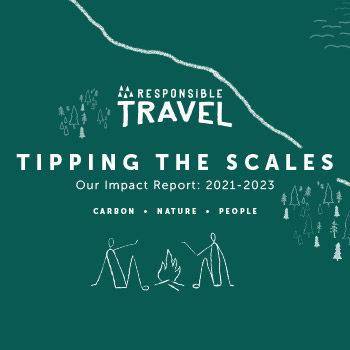
Tipping the Scales
In 2023 we published our impact report Tipping the Scales – a comprehensive overview of how we’re working with our global partners to achieve our impact goals.
Our objective to contribute to a nature positive world sits alongside our carbon goal: to deliver a 50 percent reduction in scope 1 and 2 emissions versus a 2023 baseline by 2030, and to contribute to a 50 percent reduction in scope 3 emissions by 2030.
Record profits
2023 was by far the most profitable ever year in the company’s history.
200,000th customer
In 2024 we celebrated our 200,000th customer, who visited India to see tigers. We also marked £200 million of holiday sales, excluding flights – a significant proportion of which has benefited local communities and conservation efforts.

Banking for the future
In 2024 Responsible Travel ceased its relationship with Barclays Bank due to its investments in fossil fuels and switched to Unity Trust Bank, becoming their first travel client.
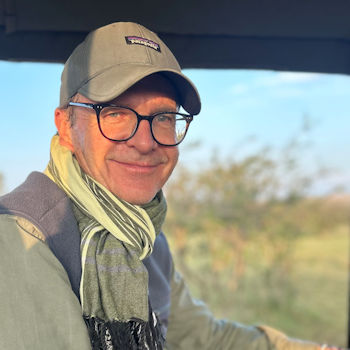
Justin receives OBE on Responsible Travel's 25th anniversary
Justin Francis founded Responsible Travel in 2000, alongside Professor Harold Goodwin and with support from mentor and Body Shop founder Dame Anita Roddick. Its goal was to drive change in the tourism industry through an alternative type of travel that aimed to reduce the negative impacts of tourism, and maximise its benefits for local places and people.
25 years on, he was awarded an OBE in the 2025 New Year Honours in recognition of services to nature and the environment.
In addition to his work at Responsible Travel, Justin also serves as nature lead for the UK Government's Council for Sustainable Business, chairs Projects for Nature, a digital marketplace connecting nature restoration projects in the UK with corporate donors, and sits on the Board of Directors for Saruni Basecamp in Kenya, a community-based safari and conservation initiative.
"It’s a huge honour to be recognised for the work that I love. The responsible travel movement has come a very long way in 25 years. I’m proud of what we’ve achieved, grateful to everyone who’s been part of creating change, and excited by the progress and innovation we’re seeing."