Our Benin holidays & tours
Our Benin holidays glimpse what lies beyond this world. The country’s animist traditions have captured the world’s imagination, and a highlight of our holidays is seeing the vodun religion practised – in fetish markets, shrines and temples and, if you’re lucky, at a festival. Yet even away from the spotlight of vodun festivals, Benin’s attractions remain magical. Lake-bound villages, Afro-Brazilian architecture, magnificent mud fortresses and some of West Africa’s last elephants combine to create a memorable trip. Spending time under the expert leadership of a local guide beyond the big cities, our holidays spread the benefits of tourism across the country. They are designed after extensive consultation with tribal elders, to ensure your trip is both authentic, and brings material benefit to the villages you visit.
Our top Benin holidays
Ghana, Togo and Benin holiday, gold and magic
From
£3499 to £3849
14 days
ex flights
Traditional villages and voodoo in Ghana, Togo and Benin
Small group2025: 22 Dec, 2026: 8 Feb, 3 Mar, 14 Apr, 7 Jul, 20 Oct, 10 Nov, 22 Dec, 2027: 2 Feb, 16 Mar, 20 Jul, 31 Aug, 19 Oct, 23 Nov, 28 Dec
Ghana, Togo and Benin holiday
From
£3799
16 days
ex flights
Culture, landscapes and Ouidah Vodoun Festival
Small group2027: 8 Jan
Voodoo Festival tour in Benin, Togo and Ghana
From
US $6495
14 days
ex flights
Experience the annual Ouidah Voodoo Festival
Small group2025: 30 Dec, 2026: 13 Jan, 27 Jan, 10 Feb, 24 Feb, 10 Mar, 24 Mar, 7 Apr, 21 Apr, 5 May, 19 May, 2 Jun, 16 Jun, 30 Jun, 14 Jul, 28 Jul, 11 Aug, 25 Aug, 8 Sep, 22 Sep, 6 Oct
Ghana, Togo & Benin tour, Ouidah voodoo festival
From
£3699 to £3999
13 days
ex flights
The magic of Benin's voodoo festival, plus Ghana and Togo
Small group2026: 7 Jan, 2027: 6 Jan
Cultural holiday in Ghana, Togo and Benin
From
£5990
25 days
ex flights
Join an amazing group trip through Ghana, Togo and Benin.
Small group2026: 11 Apr, 8 Oct, 2027: 10 Apr, 7 Oct
Togo & Benin holiday
From
£3595 to £4395
14 days
ex flights
See voodoo, unique cultures & slave history in Togo & Benin
Small group2026: 1 Feb, 24 Feb, 6 Aug, 3 Nov, 28 Nov, 26 Dec, 2027: 6 Jan, 24 Jan, 7 Feb, 21 Feb, 31 Oct, 15 Nov, 29 Nov
Ghana,Togo and Benin experience tour
From
£5995 to £6850
14 days
ex flights
Experience the culture, history and wildlife of West Africa
Tailor made
West Africa tour
From
£2745 to £3595
14 days
ex flights
Discover two small, mighty West African countries
Small group2025: 30 Dec, 2026: 25 Jul, 22 Aug, 17 Oct, 14 Nov, 2027: 8 Jan, 23 Jan, 13 Feb, 6 Mar, 7 Aug, 16 Oct, 13 Nov, 27 Nov, 30 Dec
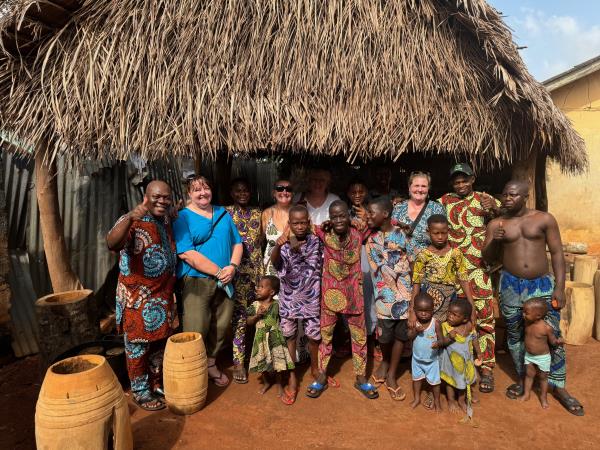
West Africa wildlife, culture and traditions tour
From
£3595 to £3895
14 days
ex flights
West African wonders of Ghana, Togo & Benin
Small group2025: 20 Dec, 2026: 7 Feb, 7 Mar, 12 Sep, 3 Oct, 7 Nov, 2027: 6 Feb, 20 Mar, 11 Sep, 2 Oct, 6 Nov
 See all our Benin holidays
Contact Us
Call us for a chat about our holidays. We are happy to discuss your holiday and help in any way we can. No bots, queues or awful hold music.

01273 823 700
Call us until 6pm
Calling from outside the UK

Benin holiday highlights

Benin is the birthplace of Voodoo, the most mysterious of religions, and it is still found here in it's purest form.
Explore the spirit of voodoo
This most enigmatic of religions originated in Benin, and while versions of it were exported across the Atlantic along with the slaves, most notably to Haiti and Louisiana, it is still found in its purest form in Benin, where it is more commonly called vodun or vodoun. Voodoo penetrates much of Beninese daily life. Visitors to markets will reveal fetish stalls, with animal fetuses and skeletons – as well as dead animals which have been prepared for rituals. Fetishes are objects which are believed to have innate powers and connections with the spirit world. As well as the animal fetishes, they can take the form of shrines – places where animals are sacrificed, wooden stakes are hammered and people make requests to the spirits, sometimes via the chief of the shrine.
Small fetishes like this exist across Benin, in backyards and compounds, but the most famous is the Dankoli shrine – a mound of festering blood, guts, bones and feathers which is believed to be the most powerful of all. Witnessing a sacrifice here – usually of a chicken, sometimes a goat – is not for the faint hearted. Rum is spat onto the fetish, cash is left to ensure a response, and requests are usually granted within a year. But be careful of making a request of your own – if your wish is granted, you must thank the gods by making a sacrifice; they won’t be pleased if you don’t.
Ouidah is the centre of voodoo, and as well as the markets, you will find the Python Temple, inhabited by around 60 sacred snakes, and the Kpasse Sacred Forest, filled with statues of voodoo gods as well as a huge iroko tree – which it is believed was once the King Kpasse, who fled into the forest from the invading Fon tribe, and turned into a tree.
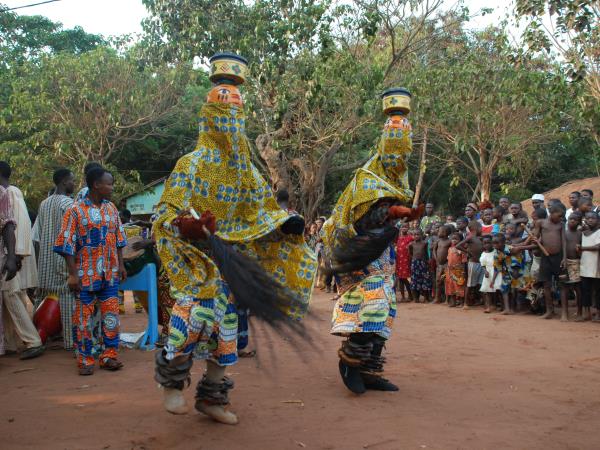
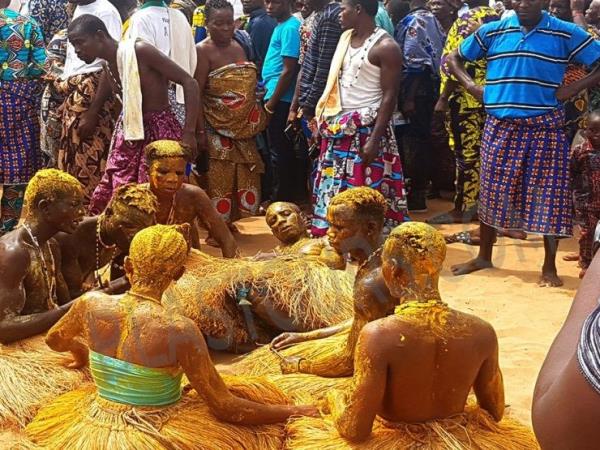
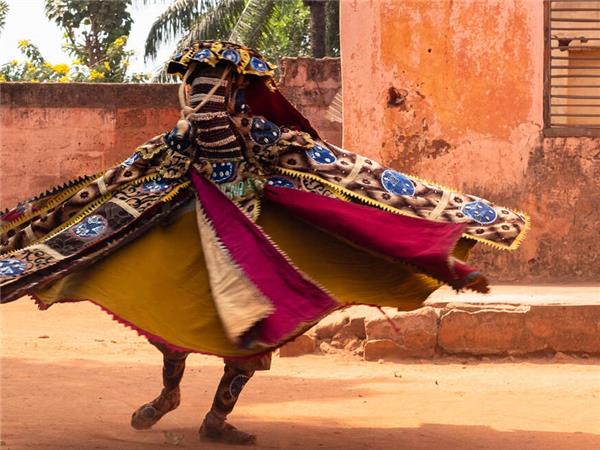
Ouidah’s annual vodun festival draws followers who transform into their chosen God for the occasion. The Zangbeto, covered in thousands of strands of raffia, perform energetic, swirling dances , while the Egungun – the most powerful – are covered entirely in colourful patchwork. There are ritual sacrifices, plus dancing, drinking and the constant beat of drums.
Small fetishes like this exist across Benin, in backyards and compounds, but the most famous is the Dankoli shrine – a mound of festering blood, guts, bones and feathers which is believed to be the most powerful of all. Witnessing a sacrifice here – usually of a chicken, sometimes a goat – is not for the faint hearted. Rum is spat onto the fetish, cash is left to ensure a response, and requests are usually granted within a year. But be careful of making a request of your own – if your wish is granted, you must thank the gods by making a sacrifice; they won’t be pleased if you don’t.
Ouidah is the centre of voodoo, and as well as the markets, you will find the Python Temple, inhabited by around 60 sacred snakes, and the Kpasse Sacred Forest, filled with statues of voodoo gods as well as a huge iroko tree – which it is believed was once the King Kpasse, who fled into the forest from the invading Fon tribe, and turned into a tree.
Ouidah’s annual vodun festival draws followers who transform into their chosen God for the occasion. The Zangbeto, covered in thousands of strands of raffia, perform energetic, swirling dances , while the Egungun – the most powerful – are covered entirely in colourful patchwork. There are ritual sacrifices, plus dancing, drinking and the constant beat of drums.
Go on safari
Impressive cross-border conservation efforts have resulted in the creation of the W-Arli-Pendjari (WAP) complex, a vast protected area that stretches across Benin, Burkina Faso and Niger. As a result of these interlinked migration routes and ecosystems, rare wildlife has been able to thrive, and Benin’s section, Pendjari National Park, one of the only places in West Africa where you can enjoy a real safari. It shelters elephants, lions, leopards, buffalo and hippos in its savannah and forest, all fed by the Pendjari River.
There are several thousand elephants in the complex – the largest population in West Africa, and in Pendjari you can track them in a vehicle or on foot with a wildlife guide. West Africa’s largest population of lions is also found here, with around 100 individuals living in WAP; unusually, the males lack the bushy manes so characteristic of their southern and eastern counterparts. Birders should keep an eye out for over 300 species that have been recorded here, including saddle-billed storks, swallow-tailed kites, booted eagles and Pel’s fishing owls.
Stay in a stilted town
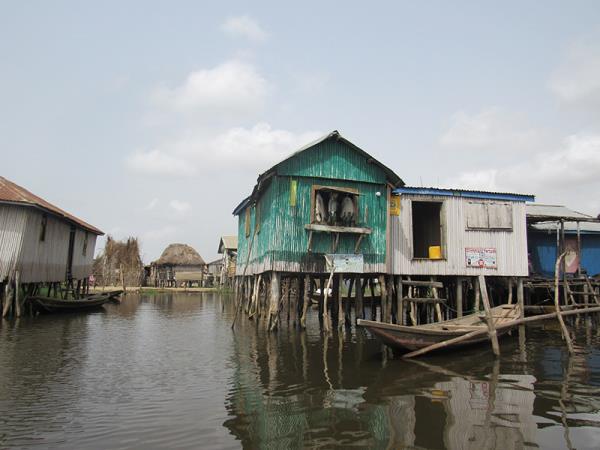
In the middle of Lake Nokoue in southern Benin, an entire town called Ganvie can be found, consisting of stilted, bamboo houses, sheltering some 20,000 residents. This unusual set up was created around four centuries ago, when the Tofinu people fled from the Fon tribe of the Dahomey Kingdom, who were out to capture people to sell into slavery. Knowing the Fon’s traditional taboos surrounding water and those who lived in it, the Tofinu – who had no such qualms – headed into the lake and set up homes here, and thus evaded capture.
Today’s Ganvians get around in dugout canoes, called pirogues. The main industry is, unsurprisingly, fishing, but you will also see little floating gardens where produce is grown, and within the town there is a school, church, little shops, and traders selling wares from their pirogues. There is also a hotel and restaurant catering to the growing number of tourists who wish to discover a most unusual lifestyle in the middle of this African lake.
Visit Batammariba tatas
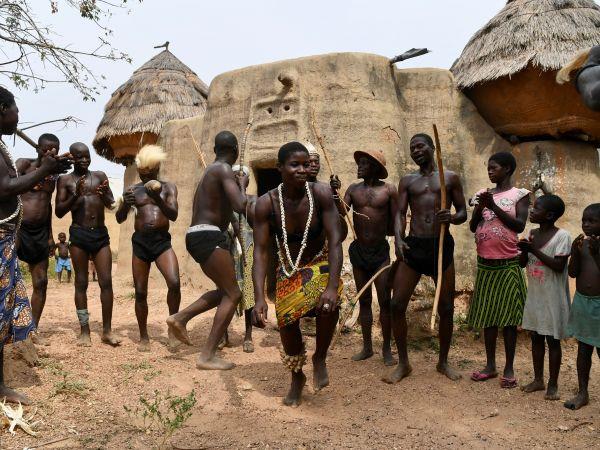
In the arid landscapes of northern Benin live the Batammariba people. They live in the areas around Natititingou, and over the border in Togo where they are known as the Taberma. Until the 1990s, the Batammariba were almost entirely cut off from the outside world, wearing traditional dress, hunting, herding and practising their own beliefs. Today, their lifestyles remain very traditional – but tourists are drawn to this remote region to see their incredible fortress-like homes, known as tatas.
Like the Tofinu, the Batammariba created this extraordinary architecture in response to the slave raids. The tatas are compounds ringed with a mud wall some three storeys high, which contains tower-like granaries. Within the walls, tall, cylindrical homes are built over two or three floors, with livestock kept in the ground floors, and a thatched roof on top. The tatas are not clustered together; when a son wants to marry, his father will fire an arrow and the son will begin to construct his own mud brick tata on the spot where the arrow lands. Traditionally, this would have been a form of protection from the invaders and slave raiders.
Discover a dark history
Abomey is the former capital of the Dahomey Kingdom, whose kings became rich by selling their enemies to European slave traders. Some estimate that the kings earned around £250,000 per year; one king described the slave trade as “the ruling principle of my people”. The legacy of horrific slave raids can still be seen across Benin. Along the coast you’ll find slave forts and a monument called La Porte Du Non Retour – the Door of No Return – the point at which captured men, women and children were loaded onto slave ships bound for the Americas. A recently created, 3km Rue des Eclaves – Walk of the Slaves, symbolises the final stretch of the route that the slaves would walk before reaching the door. It begins at the site of the old slave market, and is lined with statues and shrines commemorating those who were captured and sold into slavery.
The palace at Abomey, the former home of the kings, is also one of the most popular attractions in Benin. Inside the modest palace you’ll see items that belonged to the kings, and local guides bring this dark history to life.
Explore the architecture of enslaved peoples
Visitors to Benin’s capital, Porto-Novo, will notice something rather unusual about the architecture. In some streets, you could be forgiven for thinking you were in Brazil, thanks to the strangely Portuguese-colonial architecture of the mansions. In fact, many Afro-Brazilian formerly enslaved people returned here and along the Nigerian coast from Salvador de Bahia, following emancipation, and brought with them the architectural style of their new homeland, along with South American culinary influences which can still be tasted in Benin today. Not only does the city have a Portuguese name, but you may hear Portuguese spoken on the streets.
Cross borders
This is a great way to discover the similarities and differences between these countries, where much culture is determined by tribe and language, not official borders. Itineraries usually loop round from Accra, Ghana, making flights more convenient – and you’ll experience Anglo- and Francophone West Africa. Canoe across Lac Togo to a hidden village, visit Elmina Castle – the oldest European building in sub-Saharan Africa – and discover the vibrant spirit of the Ashanti people in Kumasi.Many itineraries take advantage of the diminutive size of many West AFrican nations, and trips usually combine Benin with neighbours Togo and Ghana.
Our Benin holidays reviews
4
30Benin holidays reviews
Kathleen Dose-Koehl22 Apr 2025
It was amazing, and Kofi Norbert (guide) and Sam (driver) were excellent. Kofi answered all of our many questions honestly and accurately. He knew the ins
and outs of border crossings, villages, and local areas, and kept us safe. The cultures in Togo, Benin and Ghana were so diverse, and so amazing. We even had
the special experience of having champagne with a king!read more
Kathryn Young29 Jan 2025
The various ceremonies and festivals where it was clear that they were taking place for locals and not for tourists. We really enjoyed West Africa and the people, and the diversity of experiences we encountered.read more
Max Hendriks07 Mar 2025
Travelling to interesting parts of the 3 countries visited to see traditions in action - 4 stars.read more