Our Angola holidays & tours
When you travel on our Angola holidays, you are travelling with experts. This vast southern African country has a 1,600km coastline, desert wilderness and a population comprised of many different tribes, from the Himba to the Muila. We’ve worked with community leaders, conservationists and elders to pave the way for sensitive travel. After years of civil strife, tourism is very new and infrastructure sparse, and travelling independently is very difficult. Our trips are expeditions lead by highly experienced teams who providing crucial support, so that you can have a rewarding expedition into the amazing hinterlands of southern Angola, and meet the many peoples who make this country so interesting.
Our top trip
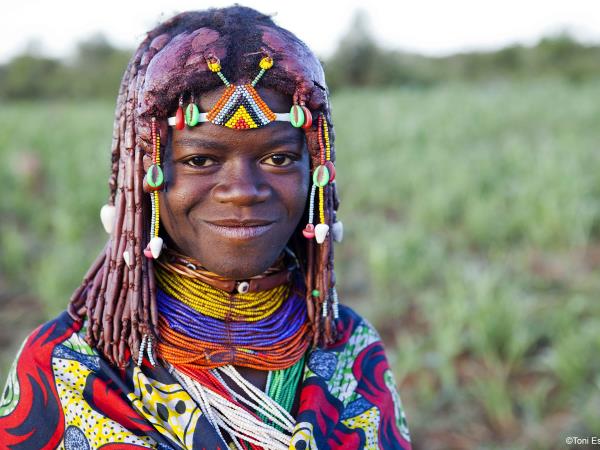
Angola holiday, Expedition to Angola
Discover the amazing tribal traditions of southern Angola
From
£4149 to £4349
11 days
ex flights
Small group travel:
2026: 5 Jul, 4 Oct
2027: 11 Jul, 3 Oct
2026: 5 Jul, 4 Oct
2027: 11 Jul, 3 Oct

Contact Us
Call us for a chat about our holidays. We are happy to discuss your holiday and help in any way we can. No bots, queues or awful hold music.

01273 823 700
Call us until 6pm
Calling from outside the UK

Angola map & highlights
You’ll need to join an organised tour to visit Angola. These are always small group trips, lasting around 10 days, and typically only departing once a year, starting and finishing in the capital, Luanda. Tours rarely spend more than half a day or so here – enough time to see a few sights – before travelling into the southwest of Angola for a cultural tour that focuses on meeting ethnic groups and learning about their traditional lifestyles. Reaching this remote region involves an internal flight from Luanda to Lubango. From here, a 4x4 will transport you over rough roads and often trackless wilderness; expect some long and bumpy journeys.
Chibia
1. Chibia
Chibia is a centre for the Muila people, known for their incredible body decorations. The Muila (also Mumuila or Mumuhuila) are semi nomadic and follow an animistic religion. The women are famous for their thick nontombi – mud-coated dreadlocks, and their mud necklaces, made in various styles. Each one of the necklaces worn by the women corresponding to a life stage, and they are never removed.
Luanda
2. Luanda
Lubango is the main city in southern Angola, sitting in a large valley overlooked by a statue of Christ and the Chela Hills. Lubango‘s centre is dominated by the Art Deco style Cathedral of St Joseph, and the city has a relaxed feel. It’s the chief jumping off point for exploration of this region and its traditional tribespeople. Nearby, the Tunda-Vala, a breathtaking kilometre-deep gorge, offers views out across the region.
Lubango
3. Lubango
Lubango is the main city in southern Angola, sitting in a large valley overlooked by a statue of Christ and the Chela Hills. Lubango‘s centre is dominated by the Art Deco style Cathedral of St Joseph, and the city has a relaxed feel. It’s the chief jumping off point for exploration of this region and its traditional tribespeople. Nearby, the Tunda-Vala, a breathtaking kilometre-deep gorge, offers views out across the region.
Namibe
4. Namibe
This quiet fishing town on the Atlantic coast is the capital of the remote Namibe Province. It was founded by the Portuguese in 1840, and is still home to fading relics of their empire. Most interesting of these is the cemetery, which has both Portuguese tombs and a curiously colourful collection of ornamental tombs, decorated in ‘Namibe style’, which is a fusion of Portuguese and African symbolism.
Oncocua
5. Oncocua
Oncocua is a former Portuguese settlement in the middle of a ‘cultural island’, where three different ethnic groups live: the Himba, the Mucawana and the Mutua. It’s a full day’s drive south of Lubango, passing villages belonging the Mugambue people. This is one of the most traditional places in southern Angola, and visitors are rare, although you can expect a warm welcome.
Tchitundo Hulo
6. Tchitundo Hulo
The prehistoric rock art here includes paintings of animals, plants and men, possibly dating back 20,000 years. Drive here from Namibe across desert landscapes and see bizarre welwitschia plants, which can live for 1,000 years. Enroute, stop in Virei, a centre for the Mucubal people, whose women wear wicker-framed headdresses, iron anklets and an oyonduthi string around their breasts, which serves as a bra.
Our Angola holidays reviews
3.5
2Angola holidays reviews
Marina Petronoti21 Jul 2024
Meeting tribal people and trying to understand their own perspective of their history, past and present mode of living. I was also intrigued by the ways in which 'tradition' co-exists with and is influenced by 'modern' clothing, diet, housing...A fulfilling expedition! read more