Our Libya holidays & tours
Our Libya holidays explore a vast country that has been off the tourist track for a long time, but is now opening its doors again to adventurous travellers. Here, ancient and well-preserved Roman ruins emerge from Saharan sands; oasis towns on old caravan routes offer shade and fascinating architectural heritage, and Berber hospitality welcomes visitors with open arms. Sure, getting around Libya is not easy – itineraries are fixed, and for now you need to join a tour organised by specialists. But it’s worth it for the thrill of being among the first international visitors to return.
Our top trip
Libya guided tour
Impressive archaeological sites & traditional towns
From
£2549 to £2649
7 days
ex flights
Small group travel:
2026: 8 Feb, 1 Nov
2027: 7 Feb, 31 Oct
2026: 8 Feb, 1 Nov
2027: 7 Feb, 31 Oct

Contact Us
Call us for a chat about our holidays. We are happy to discuss your holiday and help in any way we can. No bots, queues or awful hold music.

01273 823 700
Call us until 6pm
Calling from outside the UK

Libya map & highlights
Libya is one of Africa’s largest countries, and almost all of it is made up of inhospitable desert. Many key Roman sites, including Sabratha and Leptis Magna, lie along the Mediterranean coast, where most of the population live. Tours do drive into the desert, as far south as the former caravan town of Ghadames, via the ancient, fortified granaries of Qasr Al-Hajj. Since the demise of the Gaddafi regime Libya has had two duelling governments, ruling from east and west. Most holidays focus on western Libya, which tends to be more accessible, and offers plenty of adventure amid Saharan scenery and fascinating architecture, from Roman ruins to underground houses.
Ghadames
1. Ghadames
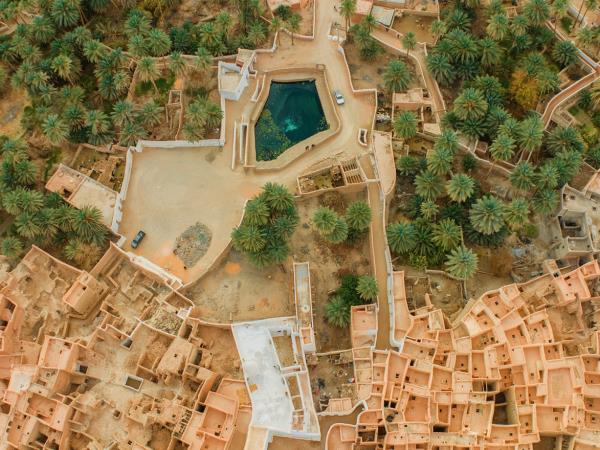
Ghadames, a UNESCO World Heritage Site, once served as a vital stopover on caravan trade routes, and today this oasis town is most notable for its traditional Saharan architecture designed to mitigate the heat. Men and children would have had communal space in the shaded alleyways while women had the privacy of open-air terraces above.
Gharyan
2. Gharyan
This mountain town directly south of Tripoli is notable for its centuries-old ‘troglodyte’ dwellings – caves hacked vertically into the rock by hand. These underground homes kept residents cool in the desert summers and snug in the winters. There are thought to be thousands of them in the mountains, and they were also used as places of worship, and as tombs.
Leptis Magna
3. Leptis Magna
The Romans were in Libya for around 800 years and left behind several notable settlements. Leptis Magna, 130km east of Tripoli, is one of the best-preserved Roman sites in the Mediterranean region, having been buried beneath the sand for centuries. Among the ruins you can see the arch of the emperor Septimius Severus, a vast amphitheatre seating 16,000, and several exceptional mosaics.
Libyan Desert
4. Libyan Desert
One thing you won’t need to bring to Libya is a raincoat. The country is almost entirely covered by the Libyan Desert, part of the Sahara Desert, and some areas can go decades without seeing so much as a drop of rain. The harsh climate has, however, resulted in stunning desert landscapes – arid plains, mountains and oases make for some seriously spectacular photo opportunities.
Sabratha
5. Sabratha
The historic region of Tripoli was so named for its three Roman cities: Leptis Magna, Oea, and Sabratha. Sabratha boasts the weathered remains of a three-storey theatre, as well as a number of temples, public buildings, and well-preserved mosaics. Sites such as this do not receive a great deal of funding, particularly given the fragile state of the Libyan economy, so the entrance fees paid by tourism is vital.
Tripoli
6. Tripoli
Most tours to Libya begin in the capital. Once known as Oea, Tripoli sits on the Mediterranean coast, its back to the desert. If you have time to spend in the city before heading further afield then head for the old town, known as the medina, where traces of Ottoman and Roman architecture can still be found, including a handful of hammams, and stuccoed caravanserai (inns along trading routes).